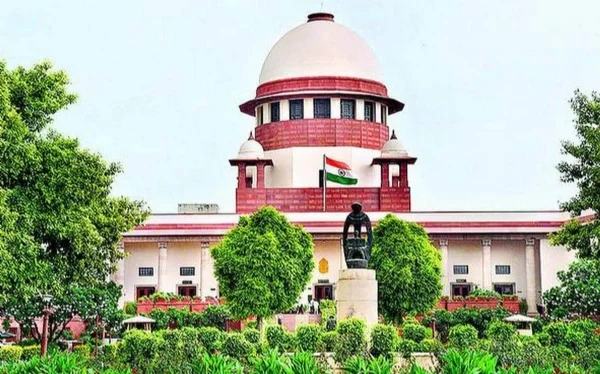
The Supreme Court of India is not merely a court of law—it is the ultimate guardian of the Constitution and the final refuge of the common citizen. Every word spoken from its benches, every order passed, and every attitude displayed during hearings shapes public perception about justice itself.
Recent contempt proceedings in the Supreme Court have brought into sharp focus a striking and disturbing contrast between two judicial approaches—one that deeply unsettled the legal fraternity and eroded public confidence, and another that reaffirmed faith in constitutional values and fair process.
Two Benches, Two Radically Different Approaches
Contempt jurisdiction is among the most sensitive powers vested in constitutional courts. It must be exercised with the highest degree of restraint, patience, and respect for due process. How judges conduct contempt proceedings therefore becomes a direct reflection of their commitment to constitutional morality.
On one side stands the approach adopted by the Bench of Hon’ble Chief Justice of India Justice Surya Kant and Hon’ble Justice Joymala Bagchi. On the other stands the approach attributed to the Bench of Hon’ble Justice Vikram Nath and Hon’ble Justice Sandeep Mehta.
The difference between the two could not have been starker.
CJI Surya Kant’s Bench: A Model of Constitutional Fairness
In contempt matters that recently came before the Bench headed by Hon’ble CJI Surya Kant, the proceedings were marked by patience, dignity, and respect for the rights of the alleged contemnors.
The CJI’s Bench not only granted a full and patient hearing but went a step further to ensure effective legal representation. Recognizing that contempt proceedings are quasi-criminal in nature, the Court offered the services of a Senior Advocate of the Supreme Court to assist the alleged contemnor—demonstrating an exemplary commitment to the principle that no person should suffer due to lack of legal assistance.
This approach fully aligns with:
- Article 39-A of the Constitution of India, which mandates equal justice and free legal aid;
- The International Covenant on Civil and Political Rights (ICCPR), which guarantees fair trial rights; and
- Binding Constitution Bench precedents which hold that a person facing contempt is entitled to all safeguards available to an accused in criminal proceedings.
Such conduct reassures the nation that even when the Court’s own authority is allegedly challenged, constitutional values remain supreme over personal indignation.
A Troubling Contrast: The Approach of Justice Vikram Nath’s Bench
Unfortunately, the approach attributed to the Bench of Justice Vikram Nath and Justice Sandeep Mehta in another set of contempt proceedings created deep concern within the Bar and among citizens.
It has been widely reported, and is clearly reflected in video recordings circulating within the legal community, that during hearings before this Bench several advocates were openly discouraged from accepting briefs of persons facing contempt proceedings. The tenor of the proceedings created a palpable atmosphere of intimidation, raising serious concerns among members of the Bar regarding their professional freedom to represent clients without fear. Senior Advocate Shri Raju Ramachandran, in the matter concerning Smt. Menaka Gandhi, as well as a group of seventeen advocates belonging to Scheduled Castes and other backward communities, were questioned for their decision to appear on behalf of individuals accused of contempt, including Smt. Menaka Gandhi and Adv. Nilesh Ojha.
Particular alarm has been caused by a statement attributed to Justice Vikram Nath suggesting that even a terrorist such as Ajmal Kasab was entitled to legal representation, but that advocates ought not to accept briefs of persons like Smt. Menaka Gandhi who were alleged to have committed contempt. Such remarks, if accurately recorded, are fundamentally incompatible with constitutional values and the settled law of the land. They directly undermine the right of an advocate to represent a client of choice and violate the corresponding right of every citizen to receive fearless and independent legal assistance.
These observations, by their very nature, strike at the independence of the Bar, weaken the adversarial system, and erode the constitutional guarantee of a fair hearing. Any judicial approach that seeks to deter lawyers from appearing for particular litigants is not merely improper—it is a direct affront to the rule of law and the basic structure of access to justice.
This stance stands in direct violation of the basic principles of natural justice, the mandate of Article 39-A of the Constitution of India, which guarantees equal justice and free legal aid, and the foundational principle of independence of the Bar, recognized as an integral component of the rule of law. The right of an advocate to accept and defend a brief, irrespective of the nature of allegations against the client, is an essential safeguard against arbitrary exercise of power.
If such a view were permitted to prevail, it would seriously undermine the adversarial system, erode the professional freedom and autonomy of advocates, and gravely prejudice the right of citizens to receive competent, independent, and fearless legal assistance. Ultimately, it would weaken public confidence in the justice delivery mechanism and dilute the constitutional promise of access to justice for all.
Evidence That Speaks for Itself
Three video recordings of the respective hearings—one before the Bench of Hon’ble CJI Surya Kant and two before the Bench of Justice Vikram Nath and Justice Sandeep Mehta—have been widely discussed in legal circles.
These recordings, according to members of the Bar who have viewed them, clearly demonstrate the difference between a calm, fair, and constitutional hearing on one hand, and proceedings perceived as intimidating and prejudicial on the other.
The comparison, therefore, is not based on subjective interpretation but on direct audiovisual record of court proceedings.
Reaction of the Legal Fraternity
The legal community has overwhelmingly appreciated the balanced, patient, and dignified approach adopted by Hon’ble CJI Surya Kant and Hon’ble Justice Joymala Bagchi in the recent contempt proceedings. Their conduct has been widely hailed as an affirmation of the finest traditions of the Supreme Court of India and as a powerful reminder that constitutional courts must always act as guardians of fundamental rights even while exercising their contempt jurisdiction. At the same time, serious concerns have been voiced within the Bar regarding the approach attributed to Justice Vikram Nath and Justice Sandeep Mehta in similar proceedings.
Reports indicate that a formal petition has already been filed before the National Human Rights Commission (NHRC) alleging violation of fundamental rights during the course of those hearings. The said petition reportedly seeks an independent inquiry into the alleged denial of fair hearing, protection of the right to legal representation, and removal of Justice Vikram Nath from the post of Executive Chairman of NALSA—a statutory body entrusted with the solemn constitutional duty of ensuring access to justice and free legal aid to citizens.
The Constitutional Position on Contempt Proceedings
The constitutional and legal position governing contempt proceedings is settled beyond any doubt. Though contempt jurisdiction is undoubtedly special in character, proceedings for contempt are essentially quasi-criminal in nature. Consequently, every person facing contempt is constitutionally entitled to the presumption of innocence, prior and clear notice of charges, a reasonable opportunity to defend, and effective legal representation. It is equally well established that if an alleged contemnor is unable to engage a lawyer on account of financial or other constraints, it becomes the duty of the Court to provide competent legal assistance at State expense.
This obligation is not a matter of discretion or charity; it flows directly from the mandate of Article 39-A of the Constitution and from the basic structure requirement of a fair and impartial trial. Any approach that seeks to intimidate advocates, discourage legal representation, or create fear among members of the Bar strikes at the root of these constitutional guarantees and directly violates settled principles of natural justice.
A Reassuring Moment: The Nedumpara Hearing
Against the backdrop of earlier disturbing incidents, a recent hearing before the Bench of Hon’ble CJI Surya Kant emerged as a reassuring and heartening moment for all those who believe in the rule of law. On 06.02.2026, the CJI’s Bench heard a writ petition filed by Advocate Mathew Nedumpara challenging what he alleged to be an unjust conviction for contempt by a previous Bench. Despite the emotionally charged nature of the matter, the Chief Justice granted a patient and uninterrupted hearing for nearly twenty minutes on the question of maintainability under Article 32 of the Constitution. When the Court sensed that the petitioner was becoming overwhelmed due to his personal involvement in the issue, the CJI gently inquired whether he would prefer to be assisted by a Senior Advocate to be provided by the Court. This single humane gesture reflected everything that constitutional justice stands for—empathy, patience, fairness, and an open judicial mind. There was no intimidation, no threats, and no display of authority—only dignified adjudication in the true spirit of constitutionalism.
Why This Matters
These contrasting experiences matter because the Supreme Court derives its moral authority not merely from the text of the Constitution but from the trust and confidence of the people. When citizens witness fairness, courtesy, and compassion from the highest court of the land, their faith in democracy and in the justice delivery system is strengthened. Conversely, when any judicial proceeding appears to deny basic rights, undermine the independence of the Bar, or create an atmosphere of fear, the damage extends far beyond an individual case and affects the credibility of the entire institution.
Conclusion: Hope Rekindled
The recent conduct of Hon’ble CJI Surya Kant and Hon’ble Justice Joymala Bagchi has powerfully reaffirmed that the Supreme Court of India remains, at its core, a court committed to justice, fairness, and constitutional values. Their approach has reminded the nation that even in contempt proceedings fairness is non-negotiable, that every litigant is entitled to dignity and effective representation, and that the true majesty of the Court lies in restraint rather than intimidation.
For this reason, the legal fraternity and the public at large have expressed deep appreciation for the leadership shown by the Chief Justice of India. At a time when confidence in institutions is often fragile, such moments of judicial statesmanship restore hope that the Constitution remains safe in the hands of those who respect its spirit and purpose.
Justice must inspire trust—and trust is built only by fairness.