A shocking verdict that has sparked widespread condemnation and concern across the legal fraternity and the judicial community.
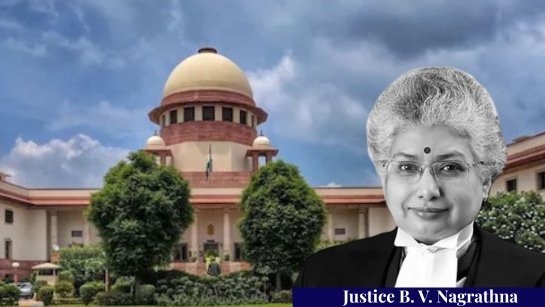
A Bench comprising Hon’ble Justice Smt. B.V. Nagarathna and Hon’ble Justice Shri R. Mahadevan not only declined to follow the binding larger Constitution Bench judgment in C.S. Karnan’s case, but also imposed costs of ₹5,000 upon the petitioner. The Bench further went on to remark that the advocates were misguided, condemned their conduct, and threatened them with action merely for acting in accordance with the law declared by the Constitution Bench of the Hon’ble Supreme Court.
This presents an unusual and troubling situation where a two-Judge Bench has refused to follow a binding Constitution Bench precedent and has imposed costs upon those who approached the Court strictly in accordance with the law laid down by the Hon’ble Supreme Court.
A lawyers’ association has reportedly filed a complaint before the Hon’ble Chief Justice of India seeking appropriate action, including prosecution, against Justice Nagarathna in relation to the said incident.
The complaint placed before the Hon’ble Chief Justice of India, Justice Surya Kant, raises serious concerns as to whether the episode reflects judicial adventurism or lack of basic knowledge or proper understanding of the settled principles of law by the learned Judge.
Justice Nagarathna has already been strongly criticised by sections of the legal fraternity for imposing a cost of ₹1 lakh on a poor father who had approached the Supreme Court seeking relief regarding the admission of his daughters, as he was unable to pay the school fees. During the proceedings, he was subjected to humiliating and insulting treatment in court and was further threatened with the imposition of an additional cost of ₹10 lakh merely for approaching the Supreme Court. Despite his emotional plea, made with folded hands and tears, his request was rejected in a manner which was harsh and lacking compassion. The issue raised concerns not only regarding the violation of the fundamental right to a fair hearing with dignity but also regarding the insensitivity displayed by Justice Nagarathna. The video recording of the said incident, along with four other similar incidents reflecting arbitrary and improper conduct, and grossly unlawful, orders has already been submitted to the Chief Justice of India by the Indian Lawyers & Human Rights Activists Association (ILHRAA).
1. Brief Summary of the case: –
1.1 A District Judge failed and refused to comply with the specific directions issued by the Hon’ble Supreme Court. In view of such wilful non-compliance with the binding orders of the Apex Court, the Petitioner, Mr. Rajeev Bansal, was constrained to approach the Hon’ble Supreme Court by filing a Contempt Petition bearing Cont. Petition (L) No. 766 of 2025 in SLP (L) No. 13255 of 2025, seeking appropriate action for disobedience of the orders of the Hon’ble Supreme Court.
1.2 The said Contempt Petition came up for hearing on 17.11.2025 before a Bench comprising Ld. Justices Smt. B.V. Nagarathna and Shri R. Mahadevan. During the course of hearing, the Bench, particularly Hon’ble Justice B.V. Nagarathna, expressed strong displeasure and observed in an intimidating tone that no contempt petition is maintainable against subordinate court judges even if they refuse to obey the orders of the Hon’ble Supreme Court. The Bench further observed that the only remedy available to the Petitioner would be to prefer an appeal before the concerned High Court The bench dismissed the petition with cost of Rs. 5,000/-.
1.3 Not only this, the learned Judges went further to caution and warn the advocates present that they should not encourage or assist litigants in filing such petitions and that action could be taken against advocates who facilitate or support the filing of such petitions. The Bench also cautioned members of the Bar against encouraging litigants to file what were described as misguided petitions.
1.4 The above position appears shocking and contrary to the settled legal framework governing contempt jurisdiction. The Sec 2(b) of the Contempt of Courts Act, 1971, along with several binding judgments of the Hon’ble Supreme Court, clearly establishes that wilful disobedience of the orders of the Hon’ble Supreme Court by any court or authority, including judges of subordinate courts, constitutes civil contempt. [ Re. M.P. Dwivedi (1996) 4 SCC 152, Re C S Karnan (2017) 7 SCC 1, Atma Ram Builders (P) Ltd. v. A.K. Tuli, (2011) 6 SCC 385, Baradakanta Misra v. Bhimsen Dixit, (1973) 1 SCC 446 , Prabha Sharma Vs Sunil Goyal (2017) 11 SCC 77] .
These judgments clearly hold that any person, including a judicial officer, who wilfully disobeys the binding directions of the Hon’ble Supreme Court can be proceeded against for civil contempt. Such acts may attract consequences under Sections 2(b), 12 and 16 of the Contempt of Courts Act, 1971, which specifically recognize that judges and judicial officers are not immune from contempt jurisdiction where there is wilful disobedience of binding judicial orders.
2. The Hon’ble Supreme Court has repeatedly held that its directions, orders, and guidelines are binding on all courts under Article 141 of the Constitution of India and any judge who wilfully disobeys or refuses to comply with the binding directions, orders, and guidelines issued by the Hon’ble Supreme Court may be held guilty of contempt of court and may further be subjected to disciplinary proceedings, including dismissal from judicial service
3. In Subrata Roy Sahara v. Union of India, (2014) 8 SCC 470 it is ruled that if a two-Judge Bench of the Supreme Court refuses to follow the order of a three-Judge Bench, then such conduct of the Two-Judge Bench would be guilty of contempt of court.
4. In Som Mittal v. Govt. of Karnataka, (2008) 3 SCC 574 Full Bench ruled that the Hon’ble Supreme Court Benches before passing any order are bound to verify that their order does not conflict with the binding precedent of the Hon’ble Supreme Court and also does not create any confusion about the binding precedents.
5. Even otherwise, under Sections 217, 218, 219 and 166 of the Indian Penal Code, 1860 (now corresponding to Sections 255, 256, 257 and 198 of the Bharatiya Nyaya Sanhita, 2023), if any public servant, including a judicial officer, knowingly passes an order contrary to law with the intention of saving a wrongdoer or causing injury or injustice to any person, such conduct may attract criminal liability and prosecution, which may extend to punishment up to seven years of imprisonment in accordance with law.
6. In Nirbhay Singh Suliya v. State of M.P., 2026 SCC OnLine SC 8 the Supreme Court Ruled that the guilty and tainted Judges must face the Criminal Prosecution to save the image of the judicial institution.
7. In New Delhi Municipal Council Vs. Prominent Hotel, 2015 SCC OnLine Del 11910 the Judgements of the action of the contempt against a Judge are summarized in detail.
8. The case of District Judge Archana Sinha, is relevant in this context. In Atma Ram Builders (P) Ltd. v. A.K. Tuli, (2011) 6 SCC 385 a Bench of the Hon’ble Supreme Court presided over by Justice Markandey Katju warned the concerned District Judge of possible imprisonment for contempt for failing to comply with the directions of the Hon’ble Supreme Court. The Court further observed that subordinate judges who deliberately disregard the binding directions of the Supreme Court are bringing a bad name to the whole institution and must be thrown out of the judiciary.
9. In the case of Prabha Sharma Vs Sunil Goyal (2017) 11 SCC 77 Supreme Court held that the Judge not following Supreme Court orders and general guidelines should face Disciplinary action. In Harish Arora v. Registrar of Coop. Societies, 2025 SCC OnLine Bom 2833 it is ruled that such Judge will be guilty of “Legal Malice” as it represents an abuse or misuse of legal authority in disregard of the established principles of law and such judges must face disciplinary action.
10. in the case of Nikhil Jain v. State (NCT of Delhi), 2025 SCC OnLine Del 6150 the Delhi High Court found serious concerns regarding judicial indiscipline where subordinate courts appeared to have ignored binding orders of the High Court and the Supreme Court while granting undeserving protection to the accused. The Court noted that despite the anticipatory bail applications having already been rejected twice by the High Court and the rejection having been upheld by the Supreme Court, the Magistrate and the Additional Sessions Judge granted relief to the accused and observed that the conduct indicated judicial indiscipline and disregard of binding precedents. Accordingly, the Court dismissed the anticipatory bail application and directed that copies of the order be sent to the Registrar General of the Delhi High Court for placing the matter before the Inspecting Committees of the concerned judicial officers, and also to the Commissioner of Police for necessary action.
11. In a recent judgment in the case of Netsity Systems (P) Ltd. v. State (NCT of Delhi), 2025 SCC OnLine SC 2079, the Hon’ble Supreme Court expressed serious concern regarding the manner in which the ACMM unlawfully granted bail in disregard of the binding precedents and the Sessions Judge declined to interfere with that illegal order. The Court observed that the judicial orders reflected a lack of proper appreciation of binding precedents and the approach expected while dealing with matters involving decisions of superior courts. Consequently, the Supreme Court directed that the concerned judicial officers undergo special judicial training for at least seven days at the Delhi Judicial Academy, with specific emphasis on sensitizing them about the conduct of judicial proceedings and the appropriate weight to be accorded to decisions of superior courts. The Court also requested the Chief Justice of the Delhi High Court and the Judicial Education & Training Programme Committee to make the necessary arrangements for such training.
12. In Rohit Kumar v. State (NCT of Delhi), 2007 SCC OnLine Del 1381, the Delhi High Court held that the observations made by the trial court were in clear disobedience of the High Court’s earlier order and bordered on contempt of court. The Court further observed that the concerned Additional Sessions Judge lacked even elementary knowledge of the Code of Criminal Procedure while passing the impugned order. In view of these serious deficiencies, the High Court directed that the judicial officer undergo a refresher training course in criminal law and procedure at the Delhi Judicial Academy for at least three months, under the supervision of the Director of the Academy, with a performance report to be submitted to the Court. The Court also directed that the judgment be circulated to all judicial officers in Delhi for guidance and that a copy be placed in the personal file of the concerned officer.
13. In New Delhi Municipal Council Vs. Prominent Hotel, 2015 SCC OnLine Del 11910, the Delhi High Court summarised various judgments of the Supreme Court and High Courts concerning the duty of subordinate courts to follow binding precedents of the High Court and the Supreme Court. The judgment further noted that where a judicial officer knowingly ignores or bypasses binding decisions of superior courts, such conduct may not be treated as a mere error of judgment but can amount to contempt of court, warranting appropriate action to preserve the authority and integrity of the judicial hierarchy.
14. In Suman Sankar Bhunia v. Debarati Bhunia Chakraborty, 2025 SCC OnLine Del 8692, the Delhi High Court strongly criticised the conduct of the concerned Family Court Judge, observing that the proceedings reflected a serious lack of understanding of basic legal principles, statutory provisions, and jurisdictional limits. The Court held that such misapprehension of law and judicial authority undermined the integrity of the adjudicatory process. Consequently, the High Court directed that the concerned judicial officer undergo an immediate and comprehensive refresher training in matrimonial laws at the Delhi Judicial Academy before adjudicating any further matrimonial matters, and ordered the Registry to communicate the judgment to the appropriate authorities for necessary action.