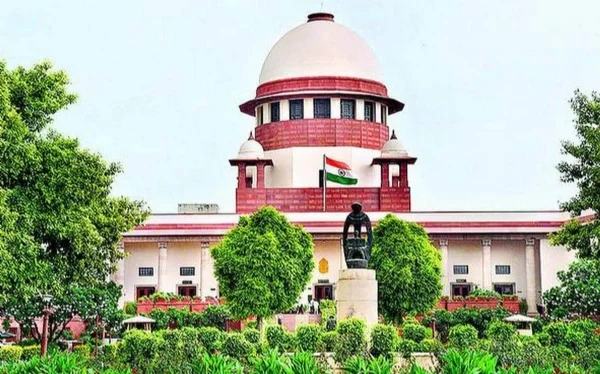
Court issued notices to the Attorney General of India, the Solicitor General of India, and the Bar Council of India.
The development gains further significance in light of a recent landmark judgment of the Supreme Court in Nirbhay Singh Suliya v. State of Madhya Pradesh, 2026 SCC OnLine SC 8, delivered by a Bench comprising Justice J.B. Pardiwala and Justice K. V. Vishwanathan where it is held that tainted and corrupt judges must face criminal prosecution in addition to disciplinary proceedings in order to protect the integrity and credibility of the judicial institution appropriate criminal accountability must follow where judicial power is abused.
Rashtriya Sanvidhan Raksha Samiti and Indian Bar Association welcomed the decision.
New Delhi: In a significant development concerning judicial accountability, the Supreme Court of India has observed that the use of fake, synthetic, or non-existent legal material in a judicial order is not a mere error but amounts to gross misconduct, directly affecting the integrity of the adjudicatory process.
A Bench comprising Justice P. S. Narasimha and Justice Alok Aradhe took serious cognizance of the issue and issued notices to the Attorney General of India, the Solicitor General of India, and the Bar Council of India.
The Court’s observations came in SLP (C) No. 7575 of 2026 — Gummadi Usha Rani v. Sure Mallikarjuna Rao, where the Supreme Court found that a trial court judge had relied upon AI-generated or non-existent Supreme Court judgments while passing an order. The High Court had earlier failed to take serious note of the issue.
In its order dated 27 February 2026, the Supreme Court observed:
“We take cognizance of the Trial Court deploying AI-generated non-existing, fake or synthetic alleged judgments and seek to examine its consequences and accountability as it has a direct bearing on the integrity of the adjudicatory process.
At the outset, we must declare that a decision based on such non-existent and fake alleged judgments is not an error in decision-making. It would be a misconduct and legal consequences shall follow.”
The Bench also directed that the trial court should not proceed on the basis of the Advocate Commissioner’s Report during the pendency of the proceedings and sought assistance from the highest law officers of the country.
LEGAL MALICE –
The Hon’ble Supreme Court has repeatedly held that a judge who acts in clear disregard of the law or binding precedents must be said to have acted with legal malice. The Court has made it clear that a judicial officer cannot defend such conduct by claiming ignorance of the law or by asserting that the order was passed with an innocent intention. Judges are presumed to know the law, and the authority vested in them obligates them to apply the correct legal principles while exercising judicial power.
The Supreme Court has further emphasised that courts are bound to apply the correct law even if it has not been specifically raised by the parties. A judge is not merely an umpire confined to the arguments of the litigants; rather, the judge has a constitutional duty to ensure that the decision rendered is consistent with the law, statutory provisions, and binding precedents of superior courts.
Accordingly, when a judge ignores or neglect the applicable law or binding precedents and passes an order contrary to law, such conduct may constitute legal malice, abuse of judicial authority, and a serious violation of the principles governing the administration of justice. Re: M. P. Dwivedi (1996) 4 SCC 152.; Priya Gupta vs. Additional Secretory (2013) 11 SCC 404, State Bank of Travancore V/s. Mathew K.C., (2018) 3 SCC 85, Sama Aruna v. State of Telangana, (2018) 12 SCC 150; Manohar Lal v. Ugrasen, (2010) 11 SCC 557.
Instances Where Judges Faced Prosecution
- Indian jurisprudence recognises that judges are not above the law. Where judicial authority is abused or exercised dishonestly, judges may face criminal prosecution, arrest, dismissal, and other legal consequences, and several such instances of investigation and prosecution of judicial officers have occurred in India.
- In State of Maharashtra v. Kamlakar Nandram Bhawsar, 2002 ALL MR (Crl) 2640, a Division Bench issued show-cause notices to the concerned Magistrate, Public Prosecutor, police officer, and advocates for attempting to place fake documents on record before the court.
- Justice Shameet Mukherjee, a judge of the Delhi High Court, was arrested by the Central Bureau of Investigation and placed in 14 days’ police custody after allegations surfaced that he had passed judicial orders in exchange for illegal gratification, including money and other inducements. The matter is reported inShameet Mukharjee Vs. CBI 2003-DRJ-70-327. Similar instances have also been examined by courts in cases such as Jagat Jagdishchandra Patel Vs. State of Gujrat 2016 SCC OnLine Guj 4517; ; K. Rama Reddy Vs State 1998 (3) ALD 305, Raman Lal Vs. State 2001 Cri. L. J. 800; Mrs. Justice Nirmal Yadav Vs. C. B. I. , 2011(4) RCR(Cri.) 809, where allegations of judicial corruption and abuse of authority were subjected to criminal investigation and legal scrutiny.
- These cases demonstrate that judicial office does not confer immunity from criminal prosecution, and where credible material indicates corruption or abuse of power, judges may be investigated, arrested, and prosecuted in accordance with law.
- In Vijay Shekhar v. Union of India, (2004) 4 SCC 666, the Supreme Court took serious note of fraud on power by a judge, observing that judicial authority cannot be exercised on the basis of extraneous or corrupt considerations.
- There are specific penal provisions under the Bharatiya Nyaya Sanhita, 2023 including Sections 198, 201, 228, 229, 255, 256, 257, 258, 259, 336(2), 337, 339, 340(2), and 356(2), as well as Section 7A of the Prevention of Corruption Act, which provide for criminal liability where a public servant, including a Judge, abuses his position by passing orders contrary to law in order to give undue favour to a party or advocate, or by creating or relying upon false or fabricated records to benefit a litigant. Under these provisions, such conduct may amount to criminal misconduct, abuse of official position, fabrication of evidence, or corruption, for which prosecution may be initiated even where direct proof of monetary gratification is not available, provided the surrounding circumstances demonstrate misuse of judicial authority. In such cases, a corrupt or dishonest judicial officer may face punishment extending up to seven years of imprisonment, along with other penal consequences.
- Further, where a judge is found to have misused public property, court machinery, or official authority for unauthorized or unlawful purposes, more serious provisions of the Sec 316(5) of Bharatiya Nyaya Sanhita may be attracted, which in certain circumstances can entail punishment extending to life imprisonment, depending upon the nature and gravity of the offence established.
- These precedents underscore that judges are not immune from accountability when judicial power is abused or exercised dishonestly.
- In R. Parekh Vs. High Court of Gujrat (2016) 14 SCC 1: 2016 SCC OnLine SC 692, case Hon’ble Supreme Court had upheld the order of dismissal of a Judge. It is ruled as under;
“A Judge passing an order against provisions of law in order to help a party is said to have been actuated by an oblique motive or corrupt practice – breach of the governing principles of law or procedure by a Judge is indicative of judicial officer has been actuated by an oblique motive or corrupt practice – No direct evidence is necessary – A charge of misconduct against a Judge has to be established on a preponderance of probabilities
- The Hon’ble Supreme Court has repeatedly emphasised that judicial integrity, impartiality and adherence to law are the foundational pillars of the justice delivery system.
- In Muzaffar Husain Vs. State of Uttar Pradesh 2022 SCC Online SC 567 the Supreme Court ruled as under:
“Showing undue favour to a party under the guise of passing judicial orders is the worst kind of judicial dishonesty and misconduct. The extraneous consideration for showing favour need not always be monetary. A judge must decide a case strictly on the basis of the facts on record and the law applicable to the case. If a judge decides a case for extraneous reasons, he is not performing his duties in accordance with law. A judge, like Caesar’s wife, must be above suspicion.”
- The Supreme Court further reiterated the central importance of integrity in the judiciary in Shrirang Waghmare v. State of Maharashtra, 2019) 9 SCC 144,observing that the very foundation of the justice system rests on the honesty and probity of judges. The Court held that:
“The first and foremost quality required in a Judge is integrity. The judiciary is an institution whose foundations are based on honesty and integrity.”
- Referring to earlier precedents including R.C. Chandel v. High Court of Madhya Pradesh and Daya Shankar v. High Court of Allahabad, the Court emphasised that judges hold public office and represent the State in the administration of justice. Therefore, the standard of conduct expected from them is far higher than that expected from an ordinary person.
- The Court further observed that judges must possess impeccable integrity, independence, and moral character, and that when a litigant enters a courtroom, he must feel assured that the judge will deliver justice impartially and uninfluenced by extraneous considerations. The Court warned that any conduct inconsistent with these standards undermines public confidence in the judiciary and threatens the very credibility of the justice system.
- The Supreme Court also clarified that “gratification” in judicial misconduct is not limited to monetary benefit, but may include other forms of improper influence, such as personal relationships, power, or other extraneous considerations.
- These judgments collectively reiterate a fundamental constitutional principle: a judge must decide cases strictly on the basis of law and the record, and any departure from this standard constitutes serious judicial misconduct that may warrant disciplinary as well as legal consequences.
- The Judge who acts in derogation of binding precedents of the Hon’ble Supreme Court, squarely attracts liability for both Civil Contempt and Criminal Contempt, punishable under Sections 2(b), 2(c), and 12 of the Contempt of Courts Act, 1971. Such conduct, being an abuse of judicial office, renders the concerned Judge liable to be punished with the maximum punishment prescribed under law, as categorically upheld in S. Karnan, In re, (2017) 2 SCC 756; Baradakant Mishra Vs. Registrar of Orissa High Court (1973) 1 SCC 374; Smt. Prabha Sharma Vs. Sunil Goyal and Ors. (2017) 11 SCC 77; Superintendent of Central Excise Vs. Somabhai Ranchhodhbhai Patel AIR 2001 SC 1975, Prominent Hotels Vs. New Delhi Municipal Corporation 2015 SCC OnLine Del 11910, Re: M. P. Dwivedi (1996) 4 SCC 152.; Priya Gupta vs. Additional Secretory (2013) 11 SCC 404, State Bank of Travancore V/s. Mathew K.C., (2018) 3 SCC 85, Tata Mohan Rao, Vs. S. Venkateswarlu, 2025 INSC 678.
- It is a settled and well-entrenched principle of law that Judges who indulge in acts tainted by bias, mala fides, or abuse of their exalted office are guilty of “Legal Malice”, “Grossest Judicial Dishonesty”, “Fraud on Power”, “Judicial Adventurism”, and “Perversity”, all of which constitute conduct wholly “unbecoming of a Judge”. Such acts stand far outside the ambit of judicial error and fall squarely within the domain of willful misconduct.
This category of misconduct amounts to “Proved Misbehaviour” within the meaning of Article 124(4) and Article 124(5) of the Constitution of India, read with Article 218, thereby attracting the constitutional process of impeachment. A Judge who betrays the solemn trust reposed in her by indulging in acts of malice, dishonesty, or abuse of power commits a “Breach of the Oath of Office”, whereby every Judge is bound to discharge duties without fear or favour, affection or ill will, and to uphold the Constitution and the laws with utmost fidelity.
The Hon’ble Courts have consistently ruled that such judicial misconduct is not a matter of mere impropriety but strikes at the heart of judicial independence and public confidence in the justice system. Errant Judges of this kind have been described in authoritative pronouncements as “ill-tuned instruments fitted in the court hall”, whose continuance on the Bench imperils the very foundation of public faith in the judiciary.
The logical and necessary consequence of such conduct is twofold:
- (i) Immediate disciplinary and penal action — including invocation of contempt, initiation of criminal prosecution where applicable, and institution of proceedings before the competent forums; and
- (ii) Administrative and constitutional measures — including withdrawal of all judicial work from such a Judge forthwith, followed by the initiation of the constitutionally mandated process of removal from judicial office.
In sum, a Judge who descends to such levels of misconduct not only renders herself incompetent and disqualified to continue in judicial office, but also becomes a violator of the fundamental rights of litigants under Articles 14 and 21 of the Constitution. The preservation of judicial purity, integrity, and accountability demands no lesser response than decisive action against such proven misbehaviour.
Relied on: –
- (a) Re: C. S. Karnan (2017) 7 SCC 1;
- (b) In , R. C. Pollard vs Satya Gopal Mazumdar 1943 SCC OnLine Cal 153;
- (c) C. Chandy Vs. R.Balakrishna Pillai, AIR 1986 Ker 116,
- (d) Baradakant Mishra Vs. Registrar of Orissa High Court (1973) 1 SCC 374;
- (e) Prabha Sharma Vs. Sunil Goyal and Ors. (2017) 11 SCC 77;
- (f) Legrand Pvt. Ltd. 2007 (6) Mh.L.J.146;
- (g) Govind Mehta Vs. State of Bihar (1971) 3 SCC 329,
- (h) Rama Reddy Vs State 1998 (3) ALD 305,
- (i) Raman Lal Vs. State 2001 Cri. L. J. 800;
- (j) Jagat Jagdishchandra Patel Vs. State of Gujrat 2016 SCC OnLine Guj 4517;
- (k) Shrirang Yadavrao Waghmare v. State (2019) 9 SCC 144,
- (l) Muzaffar Husain vs. State 2022 SCC OnLine SC 567.
- (m) P. Gupta v. Union of India, 1981 Supp SCC 87;
- (n) State of Punjab v. Davinder Pal Singh Bhullar, (2011) 14 SCC 770;
- (o) Campaign for Judicial Accountability and Reforms v. Union of India, (2018) 1 SCC 196;
- (p) Santosh Chandrashekhar Shetty v. Ameeta Santosh Shetty, 2017 SCC OnLine Bom 9938;
- (q) R. Parekh Vs. High Court of Gujrat (2016) 14 SCC 1,
- (r) Superintendent of Central Excise Vs. Somabhai Ranchhodhbhai Patel AIR 2001 SC 1975,
- (s) Umesh Chandra Vs State of Uttar Pradesh & Ors. 2006 (5) AWC 4519 ALL;
- (t) Harish Arora vs The Dy. Registrar 2025 SCC On Line Bom 2853;
- (u) Arnab Ranjan Goswami v. Maharashtra State Legislative Assembly, 2020 SCC OnLine SC 1100;
- (v) Syama Sundara Rao v. Union of India, 2006 SCC OnLine Del 1392;
- (w) Prominent Hotels Vs. New Delhi Municipal Corporation 2015 SCC OnLine Del 11910,
- (x) Re: M. P. Dwivedi (1996) 4 SCC 152.;
- (y) Priya Gupta vs. Additional Secretory (2013) 11 SCC 404,
- (z) Tata Mohan Rao, Vs. S. Venkateswarlu, 2025 INSC 678;
- (aa) State Bank of Travancore V/s. Mathew K.C., (2018) 3 SCC 85,
- (bb) Prem Kaur Vs. State (2013) 14 SCC 653;
- (cc) Vijay Shekhar v. Union of India, (2004) 4 SCC 666,
- (dd) Sama Aruna v. State of Telangana, (2018) 12 SCC 150;
- (ee) Manohar Lal v. Ugrasen, (2010) 11 SCC 557;
- (ff) Prem Kaur Vs. State (2013) 14 SCC 653;
- (gg) Kamisetty Pedda Venkata Subbamma v. Chinna Kummagandla Venkataiah, 2004 SCC OnLine AP 1009;
- That the Hon’ble Supreme Court has categorically held that where a Judge is found, on the basis of prima facie and undisputed material, to have indulged in gross misconduct, breached the oath of office, or acted in a manner unbecoming of judicial office, it becomes the solemn duty of the High Court, on its administrative side, to take immediate corrective action by forthwith withdrawing all judicial work from such Judge. This safeguard is indispensable to ensure that no litigant is subjected to prejudice or compelled to appear before a Judge whose impartiality, fairness, and integrity stand compromised. In tandem, the law requires the initiation of departmental proceedings, including steps leading to impeachment under Articles 124(4) and 124(5), read with Article 218 of the Constitution of India. Such urgent administrative measures are not optional but imperative, being essential to preserve the dignity, independence, and sanctity of this Hon’ble Court, and to maintain the confidence of the common man in the justice delivery system, which forms the very foundation of the rule of law and constitutional governance.