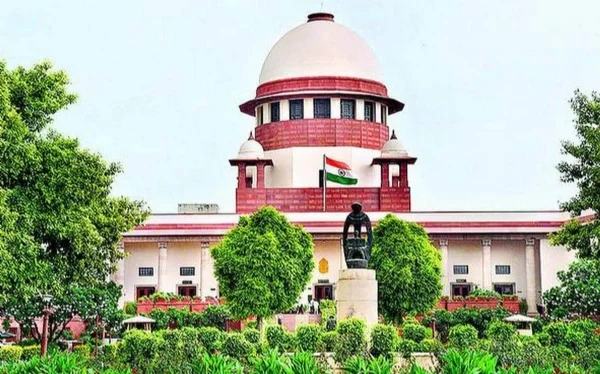
Supreme Court in the case of Ram Deo Chauhan Vs. Bani Kanta Das (2010) 14 SCC 209 admitted that there are cases where the judgments of Supreme Court had violated fundamental rights of citizen. It is admitted by the Supreme Court that the majority views of 4 Judges in a Constitution Bench headed by then CJI Sh. Y. V. Chandrachud in the case of ADM, Jabalpur v. Shivakant Shukla, (1976) 2 SCC 521 had violated the fundamental rights of the citizen and minority view of the Single Judge Sh. Khanna was, in fact, on the right side of the law, but due to majority view, injustice was done.
The ratio laid down in the case of Ramdeo Chavan (2010), is upheld by the Nine judge bench in the case of Nine Judges Bench of this Hon’ble Court in the case of K. Putaswamy vs. UOI (2017) 10 SCC 1.
The Supreme Court has accepted that even court judgments can, in rare cases, violate fundamental human rights.
- If a person is denied these guaranteed rights, it amounts to a human rights violation, and the NHRC has jurisdiction to intervene—subject to limits.
- The Court acknowledged that the assumption that Supreme Court judgments can never violate human rights is not correct. Such instances are rare, but possible.
Courts are powerful, but not infallible. Human rights violations can occur even through judgments, and the system provides checks judicial remedies and limited NHRC oversight to protect citizens’ rights.
In Ram Deo Chauhan Vs. Bani Kanta Das (2010) 14 SCC 209, it is ruled as under;
“53. Human rights are the basic, inherent, immutable and inalienable rights to which a person is entitled simply by virtue of his being born a human. They are such rights which are to be made available as a matter of right. Constitution and Legislations of civilized country recognise them since they are so quintessentially part of every human being. That is why every democratic country committed to rule of Law put into force mechanisms for their enforcement and protection. Human rights are universal in nature. The Universal Declaration of Human Rights (hereinafter referred to as UDHR) adopted by the General Assembly of the United Nations on 10th December 1948 recognizes and requires the observance of certain universal rights, articulated therein, to be human rights, and these are acknowledged and accepted as equal and inalienable and necessary for the inherent dignity and development of an individual. Consequently, though the term human rights’ itself has not been defined in UDHR, the nature and content of human rights can be understood from the rights enunciated therein.
- Possibly considering the wide sweep of such basic rights, the definition of human rights’ in the 1993 Act has been designedly kept very broad to encompass within it all the rights relating to life, liberty, equality and dignity of the individual guaranteed by the Constitution or embodied in the International Covenants and enforceable by Courts in India.
- Thus, if a person has been guaranteed certain rights either under the Constitution or under an International Covenant or under a law, and he is denied access to such a right, then it amounts to a clear violation of his human right and NHRC has the jurisdiction to intervene for protecting it.
- The contrary finding in the judgment under review about the absence of jurisdiction of NHRC to make some recommendations to the Governor is thus vitiated by errors apparent on the face of the record. Of course NHRC cannot intervene in proceeding pending in Court without its approval [Section 12(6)] as it is assumed that Court will remedy any case of violation of human rights.
- The assumption in the judgment under review that there can be no violation of a person’s human right by a judgment of this Court is possibly not correct. This Court in exercise of its appellate jurisdiction has to deal with many judgments of High Courts and Tribunals in which the High Courts or the Tribunals, on an erroneous perception of facts and law, have rendered decisions in breach of human rights of the parties and this Court corrects such errors in those judgments.
- The instances of this Court’s judgment violating the human rights of the citizens may be extremely rare but it cannot be said that such a situation can never happen.
- We can remind ourselves of the majority decision of the Constitution Bench of this court in Additional District Magistrate Jabalpur v. Shivakant Shukla reported in (1976) 2 SCC 521.
- The majority opinion was that in view of the Presidential order dated 27.6.1975 under Article 359(1) of the Constitution, no person has the locus standi to move any writ petition under Article 226 before a High Court for Habeas Corpus or any other writ to enforce any right to personal liberty of a person detained under the then law of preventive detention{ Maintenance of Internal Security Act of 1971}, on the ground that the order is illegal or malafide or not in compliance with the Act.(See paras 78 and 136 of the report)
- The lone dissenting voice of Justice Khanna interpreted the legal position differently by inter alia holding: “(8) Article 226 under which the High Courts can issue writs of Habeas Corpus is an integral part of the Constitution. No power has been conferred upon any authority in the Constitution for suspending the power of the High Court to issue writs in the nature of habeas corpus during the period of emergency. Such a result cannot be brought about by putting some particular construction on the Presidential order in question.”(Point 8 at page 777 of the report)
- There is no doubt that the majority judgment of this court in the ADM Jabalpur case (supra) violated the fundamental rights of a large number of people in this country. Commenting on the majority judgment, Chief Justice Venkatachalliah in the Khanna Memorial Lecture delivered on 25.2.2009, observed that the same be confined to the dustbin of history.’ The learned Chief Justice equated Justice Khanna’s dissent with the celebrated dissent of Lord Atkins in Liversidge v. Sir John Anderson reported in (1942) AC 206.
- In fact the dissent of Justice Khanna became the law of the land when, by virtue of the Forty Fourth Constitutional Amendment, Articles 20 and 21 were excluded from the purview of suspension during emergency.
- But we hasten to add that NHRC cannot function as a parallel seat of justice to rectify or correct or comment upon orders passed by this Court or any other Courts of competent jurisdiction. For correcting an order in a judicial proceeding, the aggrieved party has to avail of the well established gamut of the corrective machinery of appeal, revision, review, curative petition and so on.”