The aforesaid order has been passed by the Hon’ble Bench comprising Justice N. V. Anjariya and Justice Prashant Kumar Mishra.
It has already been firmly settled that making submissions contrary to binding precedents, or placing reliance upon overruled or per incuriam judgments, amounts to misleading the Court and constitutes contempt of court. Such conduct is a penal offence, and advocates are equally liable to be prosecuted along with their clients if they assist in misleading the Court. This conduct simultaneously constitutes the grossest form of professional misconduct on the part of the advocate concerned. The Hon’ble Supreme Court has further directed all courts to take serious note of such conduct by advocates and to record the same in judicial orders. [Lal Bahadur Gautam v. State of U.P., (2019) 6 SCC 441; Sajid Khan Moyal v. State of Rajasthan, 2014 SCC OnLine Raj 1450, ; State of Orissa v. Nalinikanta Muduli, (2004) 7 SCC 19, E.S. Reddi , T.V. Choudhary, In re, (1987) 3 SCC 258; Sunita Pandey v. State of Uttarakhand, 2018 SCC OnLine Utt 933 Hindustan Organic Chemicals Ltd. v. ICI India Ltd., 2017 SCC OnLine Born 74, Kusha Duruka v. State of Odisha, (2024) 4 SCC 432]
Earlier, a Full Bench of the Hon’ble Supreme Court disgracefully removed Senior Advocate Siddharth Luthra from the case by indicating that he was no longer required as Amicus Curiae, and thereafter appointed the Attorney General for India in matters arising out of writ petitions filed by Adv. Prashant Bhushan, Adv. Vijay Kurle, Adv. Nilesh Ojha, and Rashid Khan Pathan. Further, a complaint of grave professional misconduct has been lodged before the Bar Council of India against Adv. Luthra for perpetrating fraud upon the Court by obtaining orders through false and misleading statements, and for repeatedly misleading the Court by deliberately citing irrelevant, overruled, and per incuriam judgments, as well as placing reliance upon decisions of smaller Benches in direct violation of binding precedents of larger Benches — conduct which constitutes fraud on the Court and the grossest form of professional misconduct.
In Ahmad Asrab Vakil, AIR 1927 All 45, an advocate was sentenced to ten years’ imprisonment for signing false submissions in court along with his client. In M. Veerbhadra Rao v. Tek Chand, AIR 1985 SC 28, an advocate was suspended for five years for countersigning false documents. In Ashok Sarogi v. State, 2016, the anticipatory bail of the accused advocate was rejected, he being guilty of forgery of documents in collusion with his client. In Badhuvan Kunhi v. K.M. Abdulla, MANU/KE/0828/2016;, the Court initiated contempt proceedings and forwarded a reference to the Bar Council against the advocate who had suppressed material facts from the Court. In Ranbeer Singh v. State, 1990 (3) Crimes 207, the High Court directed criminal prosecution against the advocate involved in forgery.
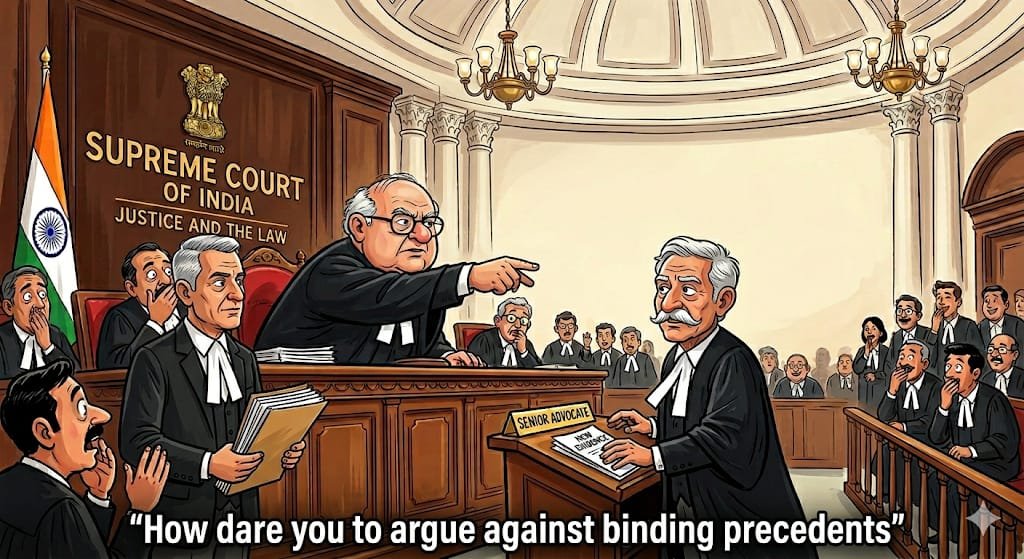
Supreme Court in Roma Ahuja v. State, 2026 INSC 336, has categorically held that advocates are duty-bound to respect binding precedents and cannot advance arguments contrary to settled law merely to display advocacy skills.
The Court emphasized that lawyers are integral to the administration of justice and must act with fairness, responsibility, and adherence to established legal principles. It was made clear that arguing against settled law or ignoring binding precedents undermines the justice delivery system and wastes valuable judicial time.
The Hon’ble Supreme Court ruled as under:
“8. As disclosure of honest and full facts before the Court is part of the fair conduct on the part of lawyers, respecting the binding precedence of the judgments and conceding its applicability in a case is also a duty in fairness to be discharged by the advocates in conducting their case. They are part of the system of administration of justice and are not expected to breach the rules of the game to argue against settled principles or contrary to well settled law, just for the sake of doing it. Giving up an argument where a point of law is already decided is a professional virtue. It is part of ethics in professional conduct before the Court.
8.1. As the courts are bound by the law of precedent and to follow the law laid down in the binding judgment of the Constitution Bench, the lawyers are also expected to respect the strong-operated precedent emanating from a judgment holding the field unless exceptional grounds exist to distinguish the decision are available. Merely for the purpose of demonstrating the argumentative skill, the lawyers ought not to eat up the valuable public time of the court by making the submissions, which are worthless against binding precedent.”
In Hindustan Organic Chemicals Ltd. v. ICI India Ltd., 2017 SCC OnLine Bom 74, the Hon’ble Bombay High Court observed as under:
“Duty of advocates not to mislead the Court even accidentally — they should come before the Court after proper online research of case law before addressing the Court. I have found counsel at the Bar citing decisions that are not good law. The availability of online research databases does not absolve lawyers of their duties as officers of the Court. Those duties include an obligation not to mislead a Court, even accidentally. That in turn casts on each lawyer an obligation to carefully check whether a decision sought to be cited is or is not good law. The performance of that duty may be more onerous with the proliferation of online research tools, but that is a burden that lawyers are required to shoulder, not abandon. Every one of the decisions noted in this order is available in standard online databases. This pattern of slipshod research is inexcusable.”
Thus, it is unequivocally settled that advocates are under a strict and non-negotiable duty to ensure that the judgments cited by them are good law, and any failure — whether deliberate or even accidental — in this regard amounts to misleading the Court and constitutes serious professional misconduct.
In the recent case of In Re: N. Peddi Raju, 2025 SCC OnLine SC 1694, a three-judge bench of the Hon’ble Supreme Court ruled as under;
“9. We wish we could have rested content with concluding the judgment with the operative portion of our conclusions on the merits of the case but we find with a sense of anguish and heaviness of heart that we have to express our disapproval of the manner in which the arguments were advanced before us on behalf of the applicant T.V. Choudhary. Not only were the arguments advanced with undue vehemence and unwarranted passion, reflecting identification of interests beyond established conventions but were of degrees not usual of enlightened senior counsel to adopt. The majesty of law and the dignity of courts cannot be maintained unless there is mutual respect between the Bench and the Bar and the counsel act in full realisation of their duty to the court alongside their duty to their clients and have the grace to reconcile themselves when their pleas and arguments do not find acceptance with the court. It is needless for us to say that neither rhetoric nor tempestuous arguments can constitute the sine qua non for persuasive arguments.
By virtue of the pre-eminence which senior counsel enjoy in the profession, they not only carry greater responsibilities but they also act as a model to the junior members of the profession. A senior counsel more or less occupies a position akin to a Queen’s Counsel in England, next after the Attorney General and the Solicitor General. It is an honour and privilege conferred on advocates of standing and experience by the Chief Justice and the Judges of this Court. They thus become leading counsel and take precedence over all counsel not having that rank. A senior counsel, though he cannot draw up pleadings of the party, can nevertheless be engaged to settle — that is, to put the pleadings into proper and satisfactory form — and hence a senior counsel settling pleadings has a more onerous responsibility, as otherwise the blame for improper pleadings will be laid at his doors.
Lord Reid in Rondel v. Worsley [(1967) 3 All ER 993, 998] has succinctly set out the conflicting nature of the duties a counsel has to perform:
‘Every counsel has a duty to his client fearlessly to raise every issue, advance every argument, and ask every question, however distasteful, which he thinks will help his client’s case. As an officer of the court concerned in the administration of justice, he has an overriding duty to the court, to the standards of his profession, and to the public, which may and often does lead to a conflict with his client’s wishes or with what the client thinks are his personal interests. Counsel must not mislead the court, he must not lend himself to casting aspersions on the other party or witnesses for which there is no sufficient basis in the information in his possession, he must not withhold authorities or documents which may tell against his clients but which the law or the standards of his profession require him to produce.’
As Lord Denning M.R. observed in Rondel v. W [(1966) 3 All ER 657, 665]:
‘He must disregard the most specific instructions of his client, if they conflict with his duty to the court. The code which requires a barrister to do all this is not a code of law. It is a code of honour. If he breaks it, he is offending against the rules of the profession and is subject to its discipline.’
We are constrained to give expression to our views with a feeling of remorse to remind the counsel of that sense of detachment and non-identification they are expected to maintain with the causes espoused by them and not with a view to belittle the profession or cast aspersions on counsel.”
Indian Bar Association Chairman Adv. Nilesh Ojha welcomed the Supreme Court decision, stating that it will help in preserving the precious time of the Courts, curb abuse of judicial process, and significantly reduce frivolous litigations, thereby strengthening the efficiency and integrity of the justice delivery system.