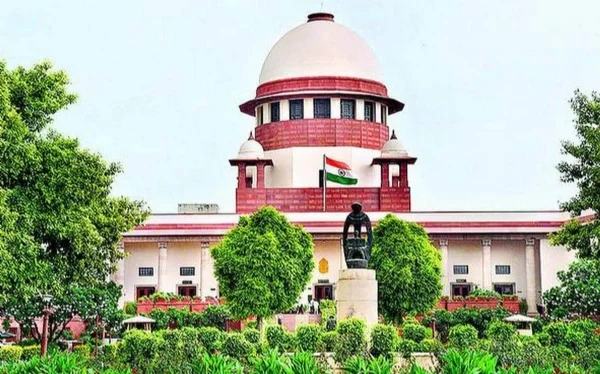
A Constitutional Misstep Rooted in Bar Council of India’s Advocate’s Fault:- The Bar Council of India and the State may be liable to pay compensation to Adv. Dhanya Kumar Jain, in accordance with the law laid down in Mahabir v. State of Haryana, 2025 SCC OnLine SC 184.
Law is very well settled that the Court is duty-bound to examine the truthfulness of the allegations made against Justice (Retd.) Sudhanshu Dhulia in accordance with law. The mere making of allegations cannot, by itself, justify denial of hearing or immediate punitive action. If, upon due consideration, such allegations are found to be false, appropriate proceedings, including perjury and contempt, may be initiated against the advocate concerned. However, if the allegations are found to be substantiated, it would equally warrant appropriate action in accordance with law including criminal prosecution like sec 257, 198 of BNS against Justice (Retd.) Sudhanshu Dhulia. Thus, the correct constitutional course is not to suppress or pre-judge the allegations, but to adjudicate upon them on merits, ensuring fairness, due process, and adherence to the principles of natural justice.
It is a settled principle of law that a court cannot threaten advocates or parties with imprisonment merely on the ground that their pleadings are alleged to be scandalous, or where the alleged contempt is said to have been committed outside the court. The power of immediate detention is an exceptional one and is ordinarily confined to cases involving direct obstruction of justice, such as instances of physical violence or disruption within the court.
Even in such exceptional circumstances, the person concerned ought to be released on bail pending trial. The due process of law—comprising a fair hearing, full opportunity to present a defence, and adjudication in accordance with established procedure—cannot be bypassed. Any attempt to short-circuit this process would amount to a violation of constitutional guarantees, including the rights to personal liberty and a fair trial, and would strike at the very foundation of justice.
The judgment in Leila David (6) v. State of Maharashtra, (2009) 10 SCC 337, which is permitting a court to bypass the mandatory process of trial and directly impose sentence without affording a full and fair opportunity of defence, is per incuriam and stands impliedly overruled by subsequent binding law.
The binding ratio continues to be the law laid down in Dr. L.P. Misra v. State of U.P., (1998) 7 SCC 379, Vinay Chandra Mishra, In re, (1995) 2 SCC 584, wherein the Hon’ble Supreme Court emphasized that contempt jurisdiction, even when invoked for alleged contempt in the face of the court, cannot be exercised by abandoning the basic safeguards of fairness, framing of charge, due process and reasonable opportunity of defence. [S. Tirupathi Rao Vs. M. Lingamaiah, 2024 SCC Online SC 1764].
This position has been further reinforced in State of U.P. v. Association of Retired Supreme Court & High Court Judges, (2024) 3 SCC 1, and Mehmood Pracha v. Central Administrative Tribunal, 2022 SCC OnLine SC 1029, where the Hon’ble Supreme Court reiterated that procedural safeguards in contempt proceedings are not empty formalities, but constitutional requirements flowing from Articles 14 and 21.
Therefore, no advocate or party can be threatened with imprisonment, detained, or sentenced merely because the pleadings are alleged to be scandalous or because contempt is alleged outside the court. A proper charge, fair hearing, adequate time for defence, and trial in accordance with law are mandatory. Any order bypassing such process is unconstitutional, without jurisdiction, and liable to be set aside.
The show cause notice issued by the Hon’ble Supreme Court to Adv. Dhanya Kumar Jain, Chairman of the MP High Court Bar Association, proposing suspension of his license to practice, appears to be contrary to the binding Constitution Bench judgment in Supreme Court Bar Association v. Union of India (1998) 4 SCC 409, wherein it has been categorically held that the Supreme Court, in exercise of its contempt jurisdiction or even powers under Article 142, does not possess jurisdiction to suspend the licence of an advocate, such power being vested exclusively with the Bar Council under the Advocates Act, 1961.
It is a matter of serious concern that this binding precedent was not brought to the notice of the Hon’ble Court by the counsel representing the Bar Council of India and the State, resulting in an order that is, prima facie, per incuriam.
In such circumstances, the principle laid down by the Hon’ble Supreme Court in Mahabir v. State of Haryana (2025 SCC OnLine SC 184) becomes directly applicable, wherein it has been held that failure of the State and its legal machinery to protect legal rights and to place the correct position of law before the Court, resulting in injustice, may render the State liable to compensate the affected party.
Accordingly, the State and the Bar Council of India, whose counsel failed in their duty to assist the Court with the correct binding law, may be liable in law to compensate Adv. Dhanya Kumar Jain for the consequences arising out of such jurisdictional error.
Members of the Bar and the Hon’ble Supreme Court are respectfully requested to exercise utmost restraint and uphold the highest standards of institutional dignity. Both pillars of justice must act with balance and constitutional discipline to preserve public confidence in the system.
While the present development, prima facie, appears to have caused grave injustice to Shri Dhanya Kumar Jain, it is expected that he will respond with composure and dignity befitting his office. Equally, the Bar must ensure that its conduct strengthens, not diminishes, the credibility of the institution.
At this stage, reflection—not reaction—is essential. It is the shared responsibility of both the Bench and the Bar to ensure that the rule of law prevails, and that institutional harmony is maintained in the larger interest of justice.
We also respectfully request the Hon’ble Supreme Court to take suo motu steps to recall the impugned order, so as to preserve and reinforce the dignity of both the Bench and the Bar, and ensure that public confidence in the administration of justice remains unshaken?
BRIEF BACKGROUND OF THE CASE :-
On 30th April 2026, the Supreme Court issued a show-cause notice to Dhanya Kumar Jain, Chairman of the Madhya Pradesh High Court Bar Association at Jabalpur, calling upon him to show cause why his licence to practise should not be suspended.
In the case of Bar Council of India vs. State of Madhya Pradesh W.P.(Crl.) No. 157/2026 it is observed as under;
“ 1. Issue notice to Respondent No. 4 to show cause as to why:
i. Proceedings for criminal contempt under the Contempt of Courts Act should not be initiated against him;
- His license to practice be not suspended; and
iii. He be not removed from the position of office bearer of the Bar.
- List the matter on 27.07.2026. ”
The notice, proposing consequences directly affecting the licence and sanad of an advocate, is directly contrary to the Constitution Bench judgment in Supreme Court Bar Association v. Union of India, (1998) 4 SCC 409, wherein it was categorically held that contempt jurisdiction and disciplinary jurisdiction over professional misconduct are separate and distinct domains, and that suspension of an advocate’s right to practise falls squarely within the statutory domain of the Bar Council under the Advocates Act, 1961?
The legal position is further fortified by An Advocate v. Bar Council of India, 1989 Supp (2) SCC 25, and Gostho Behari Das v. Dipak Kumar Sanyal, (2023) 20 SCC 158, both of which affirm that disciplinary consequences affecting a professional licence cannot be imposed outside the procedure prescribed by law. The proceedings for suspension of a sanad are quasi-criminal in nature, and an advocate facing such proceedings is entitled to all protections available to an accused in a criminal trial — including the presumption of innocence until proved guilty and the benefit of doubt.
It is well-settled by the constitution bench that no Bench of the Supreme Court, whether exercising contempt jurisdiction or its extraordinary powers under Article 142 of the Constitution, can pass any order suspending the licence of an advocate or record any finding of professional misconduct — such jurisdiction vests exclusively in the Bar Council, and proceedings for professional misconduct must be conducted in the manner of a criminal trial, strictly in accordance with the provisions of the Advocates Act, 1961 and the Bar Council of India Rules? The order issuing the impugned show-cause notice is, therefore, without jurisdiction and a nullity?
It is deeply regrettable that neither the counsel appearing for the Bar Council of India nor the counsel for the State pointed out the settled constitutional position to the Court before the impugned notice was issued?
The law on this point is well settled. In Mahabir v. State of Haryana, 2025 SCC OnLine SC 184, the Supreme Court has held that it is the duty of Senior Advocates appearing for the State and for statutory bodies such as the Bar Council of India to bring the correct legal position to the Court’s attention and thereby prevent unlawful or unjust orders from being passed? In that case, the Supreme Court imposed a compensation of Rs. 5 lakhs upon the State, payable to the accused, on account of the failure of the State’s legal officer to discharge this duty? Where counsel fails in this duty, the State is bound to compensate the person prejudiced by such failure? Shri Dhanya Kumar Jain is accordingly entitled to claim such compensation from the State as well as from the Bar Council of India, whose counsel equally failed to place the correct legal position before the Court?
Thus, any show-cause notice seeking suspension of sanad/licence in contempt proceedings, without recourse to the Advocates Act and BCI Rules, is ex facie without jurisdiction, contrary to binding precedent, and liable to be treated as a nullity.
Three Distinct Illegalities in the Impugned Order
The impugned order dated 30.04.2026 passed in Wp Crl no 157 of 2026 in the matter between BCI Vs State of MP suffers from not one but three independent and compounding illegalities?
First, as set out above, the proposed consequence of suspending an advocate’s licence falls outside the contempt jurisdiction of any Bench of the Supreme Court and is directly contrary to the Constitution Bench ruling in Supreme Court Bar Association v. Union of India, (1998) 4 SCC 409?
Second, the jurisdiction to remove a person from the post of President or Chairman of a High Court Bar Association vests in the Civil Court, for which a separate and prescribed procedure exists? The Supreme Court cannot bypass that civil jurisdiction by recourse to its contempt powers, and the ratio of Supreme Court Bar Association v. Union of India expressly prohibits such an exercise. [ See also:- Abhijeet Patil Vs Bar Council 2005 SCC On Line BOM 1514, R. N. Tiwari Vs . State Bar Council of MP 1994 SCC ON Line MP 17]
Third, the show-cause notice itself is fundamentally defective in that it does not specify, with any particularity, the exact charge or allegation that the alleged contemnor is required to answer. This is contrary to the basic principles of natural justice and to the binding Full Bench judgments which mandate that a contempt notice must contain the charge with sufficient particularity and that the framing of a charge is mandatory. Non-framing of a charge in contempt proceedings constitutes a violation of fundamental rights guaranteed under the Constitution and renders the State liable to pay compensation to the alleged contemnor. [ Ramesh Lawrence Maharaj v. Attorney General of Trinidad & Tobago, (1978) 2 WLR 902, P. Mohanraj v. Shah Bros., (2021) 6 SCC 258(3-J), Vinay Chandra Mishra, In re, (1995) 2 SCC 584 ].
Refusal to Hear the Petitioner -Advocates on the ground of allegations against judges: A Further Constitutional Infirmity
The video recording of the hearing dated 30.04.2026 discloses a further and serious constitutional infirmity? The Supreme Court declined to hear the party on the ground that allegations had been made against retired Justice Sudhanshu Dhulia? This approach is contrary to binding Constitution Bench judgments which hold that a court cannot refuse to hear a party merely because he has made allegations against a Judge — to do so is a direct violation of the audi alteram partem rule.
The correct and constitutionally mandated course is to hear the matter on merits and pass appropriate orders? If the allegations against the Judge or judicial officer are found to be false, appropriate action may be taken against the maker? If the allegations are found to be true, appropriate action — including criminal prosecution — must be initiated against the Judge at fault. The old proposition that no person may make allegations against a Judge even when supported by proof is per incuriam and contrary to both statute and Constitution Bench authority. It is specifically ruled that the pleadings against any Judge when supported by proof and based on truth does not amount to contempt even if said pleadings or allegations has an effect of shaking confidence of people in the said Judge or the institution. — see:- W.B. Electricity Regulatory Commission v. CESC Ltd., (2002) 8 SCC 715, and Nirbhay Singh Suliya v. State of Madhya Pradesh, 2026 INSC 7, S.R. Ramaraj v. Special Court, Bombay, (2003) 7 SCC 175 , Indirect Tax Practitioners’ Assn. v. R.K. Jain, (2010) 8 SCC 281; Subramanian Swamy v. Arun Shourie, (2014) 12 SCC 344, B. R. Reddy vs. State of Madras reported in AIR 1952 SC 149.
Warning by the Full Bench in Bar Council of India v. High Court of Kerala, (2004) 6 SCC 311, Contempt Jurisdiction Cannot Be Used to Silence the Bar
The Hon’ble Supreme Court itself, in its landmark three-Judge Bench judgment in Bar Council of India v. High Court of Kerala, (2004) 6 SCC 311, acknowledged — quoting Lord Denning — that contempt jurisdiction is more misconstrued and misutilised than any other jurisdiction, and held categorically that it cannot be invoked to suppress or silence the legitimate methods of advocacy? The impugned notice, if allowed to stand, would do precisely that?
The advocates are officers of the court and they are entitled for the same respect as that of a judge.
- Advocates and Judges are co-equals in administration of justice. Advocates are officers of the Court and deserve the same respect and dignity as is being given to the Judicial Officers.
- In Latief Ahmad Rather V/s. Shafeeqa Bhat, 2022 SCC OnLine J&K 249, it is ruled as under;
“6[..] Advocates are officers of the Court and deserve the same respect and dignity as is being given to the Judicial Officers and Presiding Officers of the Courts… Bench and Bar are two wheels of the chariot of justice.”
- In Ghanshyam Upadhyay v. State of Maharashtra, 2017 SCC OnLine Bom 9984, it is ruled as under;
“2[…] The Bench and the Bar are two wheels of golden chariot of institution of administration of justice. None is superior and none is inferior. Unless both of them have mutual respect for each other, the work of administration of justice cannot be effectively rendered.”
- Full Bench of Hon’ble High Court in the case of Harish Chandra Mishra V/s. Hon’ble Mr. Justice S. Ali Ahmed, 1985 SCC OnLine Pat 213; it is ruled as under;
“27.A Judge has every right to control the proceedings of the court in a dignified manner and in a case of misbehaviour or misconduct on the part of a lawyer proceedings in the nature of contempt can be started against the lawyer concerned. But, at the same time a Judge cannot make personal remarks and use harsh words in open Court which may touch the dignity of a lawyer and bring him to disrepute in the eyes of his colleagues and litigants. Lawyars are also officers of the court and deserve the same respect and dignity which a Judge expects from the members of the Bar.
The Judge has also a reciprocal duty to perform and should not be discourteous to the counsel and has to maintain his respect in the eyes of clients and general public. This is, in my view, very important because the system through which justice is being administered cannot be effectively administered unless the two limbs of the court act in a harmonious manner. Oswald on Contempt of Court, 3rd Edition at page 54 remarked “an over subservient bar would have been one of the greatest misfortune that could happen to the administration of Justice.”
- Greatest of respect for my learned Brethren it is not possible for me to agree with the proposition that the Judges of the High Courts and the Supreme Court are immune from a contempt of courts proceeding nor do I agree that an application filed without the consent in writing of the Advocate General is not maintainable.
- The Bench and the bar are the two vital limbs of our judicial system and nothing should be done on either side in haste to impair the age-old cordial relationship between these two limbs. It is no mean achievement of this system that inspite of stains and stresses the Bench and the bar have maintained the ideal and harmonious relationship.
- This is rather an unfortunate case, in which a Judge and a member of the Bar after a wordy duel in the midst of a case came to a clash, resulting in filing of this application..[..].
- In Muthukrishnan V/s. High Court of Madras, (2019) 16 SCC 407, it is ruled as under;
“It is duty of the lawyer to lodge appropriate complaint to the concerned authorities as observed by this Court in Vinay Chandra Mishra (supra), which right cannot be totally curtailed.
……..Making the Bar too sycophant and fearful which would not be conducive for fair administration of justice. Fair criticism of judgment and its analysis is permissible. Lawyers’ fearlessness in court, independence, uprightness, honesty, equality are the virtues which cannot be sacrificed.
It is the duty of the Bar to protect honest judges and not to ruin their reputation and at the same time to ensure that corrupt judges are not spared.”
- The Bar Council of India Rules states;
Rule I – Duty to the Court
“1. An advocate shall, during the presentation of his case and while otherwise acting before a court, conduct himself with dignity and self-respect. He shall not be servile and whenever there is proper ground for serious complaint against a judicial officer, it shall be his right and duty to submit his grievance to proper authorities.”
- In High Court of Karnataka V/s. Jai Chaitanya Dasa, 2015 SCC OnLine Kar 549, it is ruled as under;
“196[…] Respect and allegiance which the Counsel owes is not to the person of the Judge but to his office. The duty of courtesy to the Court does not imply that he should not maintain his self-respect and independence as his client’s Advocate. Respect for the Court does not mean that the Counsel should be servile. It is his duty, while respecting the dignity of Court, to stand firm in advocacy of the cause of his client and in maintaining the independence of the Bar. It is obviously-in the interests of justice that an Advocate should be secured in the enjoyment of considerable independence in performing his duties. An over subservient Bar would be one of the greatest misfortunes that could happen to the administration of justice.
193[…] It is questionably true that courtesy breeds courtesy and just as charity has to begin at home, courtesy must begin with the Judge. A discourteous Judge is like an ill-tuned instrument in the setting of a Court room. But members of the Bar will do well to remember that such flagrant violations of professional ethics and cultured conduct will only result in the ultimate destruction of a system which no democracy can survive.
- The legal profession is a solemn and serious occupation. It is a noble calling and all those who belong to it are its honourable members.
198[…] His status as an officer of justice does not mean that he is subordinate to the Judge. It only means that he is an integral part of the machinery for the administration of justice.
- Advocates share with Judges the function that all controversies shall be settled in accordance with the law. They are partners in the common enterprise of the administration of justice. The difference in their roles is one of division of labour only; otherwise they are two branches of the same profession and neither is superior or inferior to other. This fact is now recognized in India by the autonomy given to the Bar by The Advocate Act, 1961. Judges cannot do without the help of advocates if justice is to be administered in accordance with law, and its administration is to command popular confidence. It is the function of an advocate not merely to speak for the client, whom he represents, but also to act as officer of justice and friend of the Court. The first duty which advocates and Judges owe to each other is mutual co-operation, that is a fundamental necessity. Without it there can be no orderly administration of justice. Nothing is more calculated to promote the smooth and satisfactory administration of justice than complete confidence and sympathy between Bench and the Bar. If the Advocate has lost confidence of the Bench he will soon lose that of his clients. A rebuke from the Bench may be fatal to his chances of securing a high standing at the Bar.Similarly if the Judge has lost confidence of the Bar he will soon lose confidence of the public.
- There is the danger of a Judge placing over emphasis on the dignity of the Court in a manner which would be in conflict with the equally valuable principle of independence of the Bar in the advocacy of causes.”