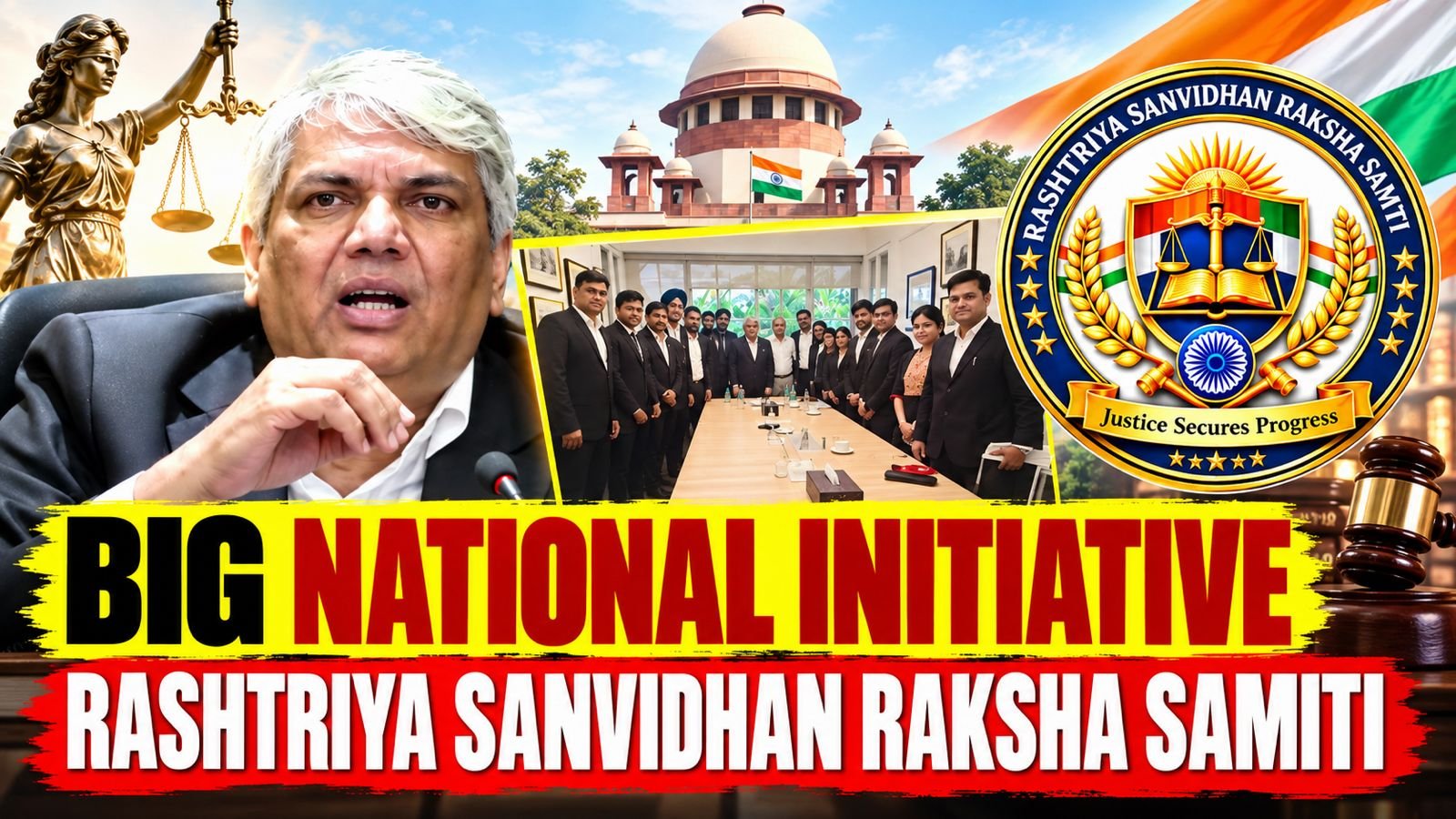
Rashtriya Sanvidhan Raksha Samiti launches major initiative; National President Adv. Nilesh C. Ojha outlines roadmap, nationwide membership drive to begin soon
Retired Indian Army and defence officers, former RAW-IB officials, former judges and retired IPS-police officers to join lawyers, journalists, doctors, human rights and RTI activists, workers, businesspersons, women, youth, young advocates of the Gen-Z Lawyers Association and ordinary citizens
Mumbai: The Rashtriya Sanvidhan Raksha Samiti is preparing to launch a nationwide campaign aimed at reforms in the judicial, police and administrative systems, strengthening accountability against corruption, and ensuring speedy, impartial and dignified access to justice for ordinary citizens.
Giving details of the initiative, the Samiti’s National President, Adv. Nilesh C. Ojha, said the campaign would not merely highlight shortcomings in the system. Its focus would be on identifying fundamental problems affecting citizens, studying their root causes and placing before the country concrete, legally sound and practically implementable solutions.
Ojha said the Samiti has already studied several systemic issues affecting ordinary citizens and has also prepared draft proposals for legal, administrative and institutional reforms.
“We will not merely point out what the problem is. For every problem, we will place before the country a practical solution, the reforms required and a clear roadmap for implementation. Our approach will be ‘Problem + Solution + Action’,” Ojha said.
1,000 representatives to assemble in Mumbai
As the next major step, the Samiti plans to organise a special conference of around 1,000 selected representatives in Mumbai. The date, venue and detailed programme will be announced shortly, Ojha said.
According to him, the conference is intended to bring together people with experience in national security, defence, the judiciary, policing, administration, law and public affairs, along with representatives from different sections of society.
The proposed participants include retired senior officers of the Indian Army and other defence services, former and retired officials associated with the Research and Analysis Wing (RAW) and Intelligence Bureau (IB), former judges and retired officials associated with the judiciary, former IPS and senior police officers, and retired senior administrative officers.
They will be joined by lawyers, journalists, doctors, human rights activists, RTI activists, workers and representatives of the labour community, businesspersons, social activists, women, youth, young advocates associated with the Gen-Z Lawyers Association and ordinary citizens.
Core committee includes experienced former officials and experts
Ojha said the Samiti is also associated with a core committee comprising experienced individuals from different fields.
According to him, the core committee includes retired senior officers of the Indian Army and other defence services, former and retired officials associated with RAW and IB, former judges and retired judicial officials, former IPS and senior police officers, retired administrative officials, experienced legal experts and other distinguished professionals and thinkers.
Ojha said these individuals have been extending their experience, expertise, suggestions and guidance to the initiative from time to time. Their participation and guidance will now be brought into the nationwide campaign in a more organised and formal manner.
‘We will not just identify problems; we will present solutions’
Ojha said merely criticising the system or organising protests would not be sufficient to achieve meaningful reform.
According to him, the Samiti has studied several fundamental issues concerning the judiciary, police and administration that directly affect ordinary citizens and has prepared proposals addressing possible solutions and reforms.
The campaign will therefore follow the “Problem + Solution + Action” model.
Each identified issue will be taken up separately. The problem, its proposed solution, the legal or administrative reforms required and a roadmap for implementation will be presented before the public.
The campaign will use public awareness programmes, expert consultations, public dialogue, legal initiatives and, wherever necessary, peaceful, democratic and constitutional public movements to pursue these reforms.
‘Why should an ordinary citizen have to wait years for justice?’
Ojha said one of the central questions behind the campaign is why an ordinary citizen should have to struggle for years to secure justice or enforce a lawful right.
The objective, he said, is to work towards a system in which citizens can obtain speedy and impartial justice without corruption, discrimination or unnecessary delay, while also ensuring respectful treatment of citizens and an environment in which honest and conscientious public officials can discharge their duties without fear.
The Samiti maintains that the law and the legal process must operate equally for the poor, the ordinary citizen and the influential alike.
‘Zero Tolerance’ towards corruption
A policy of “Zero Tolerance” towards corruption will be one of the principal themes of the campaign.
Ojha said that if any public official, police officer, bureaucrat or judicial officer is found guilty, in accordance with law, of corruption, abuse of authority or serious misconduct, there should be a system capable of ensuring swift, effective and lawful action irrespective of the person’s office, status or influence.
He emphasised that the campaign is not intended to weaken any institution.
“Our objective is not confrontation with institutions, but reform of the system. The judiciary, police and administration must become stronger, more transparent and more accountable. Honest officers should receive respect and protection, while the law must apply equally in cases of corruption or abuse of power,” Ojha said.
Special emphasis on participation of women and youth
The Samiti also plans to give particular emphasis to the participation of women and young people.
According to Ojha, reforms in the justice, police and administrative systems cannot remain a subject confined to lawyers, officials or experts because the functioning of these institutions directly affects every citizen.
Workers, businesspersons, professionals, social activists, women, youth and ordinary citizens will therefore be encouraged to participate in the campaign.
The young advocates of the Gen-Z Lawyers Association will also be associated with the initiative with a view to increasing the participation of the younger generation of legal professionals.
Expansion to states and districts after Mumbai conference
Following the proposed Mumbai conference, the campaign will be expanded in phases across the country.
Ojha said the Samiti plans to expand its organisational network and establish units at the state, district and city levels.
A nationwide membership drive will also be launched shortly to enable citizens who believe in constitutional governance, the rule of law, a corruption-free system and institutional reforms to formally associate themselves with the campaign.
Membership applications will be made available through the Samiti’s official website. Information relating to upcoming programmes, meetings, research material, reform proposals and future action plans will also be published through the website from time to time.
‘Problem + Solution + Action’ to be the foundation
Ojha said the Samiti has already undertaken studies of several fundamental issues concerning the judiciary, police and administration and has prepared draft reform proposals on various subjects.
These issues will now be presented before the public one by one, along with the nature of the problem, the proposed solution and the action required for implementation.
The process will involve expert consultations, public awareness, legal initiatives, dialogue and, wherever required, peaceful and constitutional public mobilisation.
‘Equal before the law’ to be the central message
Ojha said the campaign would carry the following messages:
“Everyone is equal before the law — the process of law must also be equal for everyone.”
“Speedy justice for every citizen — without corruption, without discrimination.”
“Respect for citizens — respect for honest public officials.”
“Zero Tolerance towards corruption — however influential the offender may be, the law must remain equal for all.”
“The country must be governed by the Constitution — not by the power of any individual, office or influence.”
“A strong justice system means a stronger nation.”
Ojha said the initiative is intended to be more than a protest movement. It is being conceived as a nationwide campaign for constructive and lasting institutional reform.
The ultimate objective, he said, is to work towards a system in which ordinary citizens do not have to spend years seeking justice, honest officials are able to discharge their duties without unnecessary institutional obstacles, and no corrupt individual can evade the law merely because of position, money or influence.
“The Constitution is supreme — the law is equal for all — justice is the right of every citizen.”