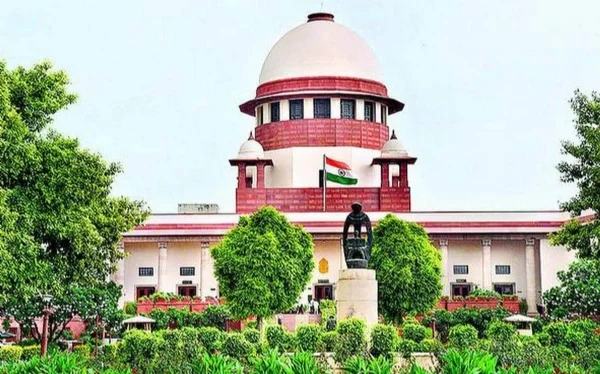
The incident has triggered widespread public outrage, with complainants alleging that the judge’s conduct violated the constitutional right to a fair, dignified, and respectful hearing. They contend that judges are entrusted with the duty to protect and uphold citizens’ constitutional rights and not to infringe and violate them.
Similarly, a major controversy had earlier arisen over the allegedly harsh and threatening remarks made by Justice Ahsanuddin Amanullah in the Patanjali matter. On that occasion, several Supreme Court judges and former Chief Justices publicly expressed strong disagreement and deep concern through an article published in The Times of India, and advised that the legal principles on judicial conduct laid down in C. Ravichandran Iyer v. Justice A. M. Bhattacharjee (1995) 5 SCC 457 be read and followed.
Title: SC judge’s ‘rip you apart’ comment riles present, former judges
In this context, comparisons are being drawn between the alleged conduct of Chief Justice Surya Kant and Justice Nagarathna. Recently, during the hearing of the writ petition Mathew Nedumpara v. Supreme Court of India, filed under Article 32 of the Constitution, Chief Justice Surya Kant heard the petitioner’s submissions with complete calm and patience, in a manner consistent with the dignity of the Supreme Court. While maintaining courtroom decorum, he also informed the petitioner that if legal assistance was required, the services of a senior advocate could be arranged so that the case could be presented properly and effectively. The petition was thereafter dismissed on the basis of law and the record.
Although the Chief Justice disagreed with the petitioner’s submissions, his conduct was in no way disrespectful. Even though the order went against the petitioner, there were no personal remarks, reprimands, or expressions that could injure the petitioner’s dignity. Nor was any punitive cost — such as a fine of one lakh rupees — imposed.
In stark and deeply troubling contrast, it is alleged that Justice Nagarathna and Justice Ujjal Bhuyan treated the same poor complainant — a father who had come seeking justice for his daughter — in a manner that was entirely different, humiliating and wholly unworthy of the nation’s highest court.
The comparison speaks for itself. And it is damning.
The complainant’s argument cuts to the heart of the matter — the power of a court does not begin and end with the orders it passes. The language used from the bench, the tone adopted toward a litigant, the atmosphere created inside that courtroom — these are not incidental. They are inseparable from justice itself.
If the Chief Justice’s Bench can firmly dismiss a petition while maintaining every standard of courtesy, restraint and human sensitivity — then there is no bench in this country, and no judge, who can justify harsh language, a humiliating tone, or an excessively punitive approach as a “judicial necessity.” According to the complainant, it is a disturbing and deeply troubling feature that strikes at the very soul of the justice system.
This, the complainant contends, is the fundamental and unbridgeable distinction between “justice” and “justice with dignity.”
And that distinction matters — not just for one poor father, not just for one case — but for every citizen who walks through the doors of a court of law believing that the Constitution stands behind them.
This is not an individual grievance. This is a question about what kind of institution the Supreme Court of India chooses to be.
This episode has unleashed a wave of public fury across the nation. Citizens from every walk of life are openly and vocally condemning the alleged indecent and humiliating conduct of a sitting Supreme Court judge. The tears streaming from a poor father’s eyes today are not merely the grief of one family — they have become the voice of crores of ordinary Indians who approach the doors of this country’s highest court carrying nothing but hope.
That hope is now shaken. And the nation is not staying quiet.
This public outrage is rapidly evolving into a broad national awakening. The people of India are sending one clear, unambiguous message — no judicial chair, however powerful, gives anyone the right to trample upon the dignity of a common man.
Justice Nagarathna is next in line to become the Chief Justice of India. But the tears of a man who sought justice from this country’s highest court — and received humiliation instead — now stand as a grave moral and constitutional question mark directly on that path.
Few Judges like Justice Nagarathna Also Appears to Have Forgotten — Advocates Are Officers of the Court. They Are Not Subordinates to Be Bullied.
There is a fundamental principle of law that Justice Nagarathna appears to have overlooked — advocates are officers of the court. They do not appear before a judge as supplicants. They appear as equals in the pursuit of justice. And the law is unambiguous — judges are bound to extend to advocates the same dignity and respect that they expect for themselves.
Any misconduct, intimidation or humiliation directed at an advocate by a judge is not a matter of judicial discretion. It is a punishable act. A judge who behaves in such a manner renders himself or herself liable to action under: — Contempt of Court — Defamation — Criminal Intimidation — Payment of Damages to the aggrieved advocate
This is not a novel legal proposition. It is settled law, affirmed repeatedly by courts across this country:
Muhammad Shafi v. Choudhary Qadir Bakhsh, 1949 SCC OnLine Lah 14 Bidhi Singh v. M.S. Mandyal, 1993 Cri LJ 499 ; B.S. Sambhu v. T.S. Krishnaswamy, (1983) 1 SCC 11 ; Mehmood Nayyar Azam v. State of Chhattisgarh, (2012) 8 SCC 1; Latief Ahmad Rather v. Shafeeqa Bhat, 2022 SCC OnLine J&K 249 Ghanshyam Upadhyay v. State of Maharashtra, 2017 SCC OnLine Bom 9984 ; Harish Chandra Mishra v. Hon’ble Mr. Justice S. Ali Ahmed, 1985 SCC OnLine Pat 213 ; R. Muthukrishnan v. High Court of Madras, (2019) 16 SCC 407; High Court of Karnataka Vs. Jai Chaitanya Dasa & Others 2015 (3) AKR 627, ; Chetak Construction Ltd. v. Om Prakash, (1998) 4 SCC 577; ; Ramesh Lawrence Maharaj v. Attorney General of Trinidad & Tobago, (1978) 2 WLR 902 ; McLeod v. St. Aubyn, [1899] AC 549 ; Walmik Bobde v. State of Maharashtra, 2001 ALL MR (Cri) 1731 Sailajanand Pande v. Suresh Chandra Gupta, 1968 SCC OnLine Pat 49 : AIR 1968 Pat 194.
The bench is not a throne. The robe is not a shield. And the gavel is not a weapon to be wielded against the very people who keep the wheels of justice turning.
An advocate humiliated in court is not just a personal wrong — it is an assault on the justice system itself.
The law sees it that way. And the complaint demands that the authorities act accordingly.
This country never forgets the humiliation of its common citizen. And it will not let the world forget it either.
Justice Nagarathna Allegedly Did the Exact Opposite to the prohibition laid down in the case of P. Radhakrishnan & Anr. v. Cochin Devaswom Board & Ors., 2025 INSC 1183
The Supreme Court in P. Radhakrishnan & Anr. v. Cochin Devaswom Board & Ors., 2025 INSC 1183 held that if a bench takes parties by surprise, makes strong observations and directions, it will create a chilling effect on prospective litigants. They will be left to wonder — “if I go to court seeking justice, will I leave worse off than before?” The Supreme Court warned that this could seriously impact access to justice and consequently the very rule of law — and directed that courts must exercise great caution and circumspection. That is the law. That is the binding standard set by the Supreme Court itself.
And according to the complaint — Justice Nagarathna violated every word of it.
A Poor Father. A Daughter. A Fight for Free Education. And Then — This.
The facts of this case are as simple as they are heartbreaking.
A poor father approached the Supreme Court seeking admission for his daughter under the Right to Education Act — free education that the Constitution itself guarantees to every child. He was not a wealthy litigant gaming the system. He was not a frivolous petitioner wasting the court’s time. He was a father who could not afford school fees — and who believed, with complete faith, that the Constitution of India stood behind him and his daughter.
He came to the Supreme Court as a citizen exercising his fundamental right.
What he allegedly received in return was intimidation, humiliation, threats — and a punitive cost of Rs. 1,00,000.
A man who came to court because he could not pay school fees was ordered to pay one lakh rupees.
He left the Supreme Court worse off — financially, emotionally and constitutionally — than the day he arrived.
This is precisely the situation the Supreme Court in P. Radhakrishnan declared must never be allowed to happen.
This Is Not Judicial Error. This Is a Constitutional Breach.
According to the complaint, Justice Nagarathna did not merely make a mistake in judgment.
She allegedly:
— Insulted, threatened, intimidated and publicly humiliated a poor father inside the Supreme Court, — Imposed a punitive cost of Rs. 1 lakh on a man who came seeking free education for his daughter under the RTE Act, — Violated the binding guidelines of the Supreme Court’s own Constitutional Bench, — Breached her solemn oath of office — to act fairly, to uphold the law and to protect the Constitution of India, and — Committed contempt of the Supreme Court’s own binding directions on judicial conduct and courtroom decorum.
That is not a judicial order. That is an abuse of judicial power. That is not a strict judge. That is a constitutional violation. That is not justice. That is the destruction of access to justice — from within the walls of the institution sworn to protect it.
The Chilling Effect — Already Here, Already Spreading
The Supreme Court warned of a chilling effect.
According to the complaint, that chilling effect is no longer a theoretical risk. It has arrived. It is real. It is documented. It is on video.
Every poor citizen watching this case is now asking themselves —
“If a father who sought free education for his daughter under the RTE Act was humiliated and fined one lakh rupees — should I even bother going to court?”
Every advocate watching this case is asking —
“If I appear before a bench and speak up for my client — will I face threats and public humiliation?”
That is the chilling effect the Supreme Court feared. And according to the complaint — Justice Nagarathna created it.
The Oath She Took. The Law She Violated.
Every judge of the Supreme Court of India takes a solemn constitutional oath —
To bear true faith and allegiance to the Constitution. To uphold the sovereignty and integrity of India. To duly and faithfully perform the duties of the office to the best of ability, knowledge and judgment — without fear or favour, affection or ill-will.
According to the complaint, that oath was broken in that courtroom on that day.
Not by a litigant. Not by an advocate. By the judge herself.
The law is clear. The breach is documented. The nation is watching.
Justice must now be done — and it must be seen to be done.
The Evidence Is on Record — Four Incidents, Video Proof
The complaint presents detailed evidence and video recordings of approximately four separate incidents of alleged misconduct by Justice Nagarathna. On the basis of this evidence, it is contended that Justice Nagarathna:
— Violated orders and directions issued by the Constitutional Bench of the Supreme Court of India,
— Caused serious damage to the institutional dignity of the nation’s highest court, and
— Is thereby herself liable to action under contempt of the Supreme Court’s orders and contempt of court.
The Law Is Clear — And the Supreme Court Has Said So Itself
This is not the first time that alleged rude, discourteous or threatening conduct by a judge has come under scrutiny. In earlier such cases, the Supreme Court itself has made stringent observations, unequivocally establishing that a person occupying judicial office is expected to maintain the highest standards of restraint, courtesy and impartiality.
The Supreme Court has held in categorical terms — a rude judge has no place in the judiciary. Such a judge must be removed from service and must also face contempt of court proceedings as well as other legal and criminal action.
The law on this point is settled, clear and binding:
R.K. Garg v. State of Himachal Pradesh, (1981) 3 SCC 166 C. Ravichandran Iyer v. Justice A.M. Bhattacharjee, (1995) 5 SCC 457 Muhammad Shafi v. Choudhary Qadir Bakhsh, 1949 SCC OnLine Lah 14 Bidhi Singh v. M.S. Mandyal, 1993 Cri LJ 499
The precedents are there. The evidence is there. The complaint is filed.
Now the question is — will the system act promptly for the poor father and advocates?
This entire episode has reignited a fierce national debate on judicial conduct, judicial accountability, and the fundamental right of every citizen to a respectful and dignified hearing.
The Complaint — Who Filed It, What It Says, and Why It Matters
The Indian Lawyers and Human Rights Activists Association (ILHRAA) has filed a detailed formal complaint before the Rashtrapati Bhavan and the Chief Justice of India, alleging “humiliating, intimidating and contemptuous” conduct during Supreme Court proceedings. The complaint states that a poor litigant was subjected to an atmosphere inside the courtroom that was wholly and brazenly contrary to his constitutional right to a fair and respectful hearing.
Who Is Named — And What Is Alleged
The complaint levels serious allegations against Justice B.V. Nagarathna and Justice Ujjal Bhuyan regarding their conduct in court. Justice R. Mahadevan is also referenced in the document as a member of the bench and co-signatory in certain orders. The complainants contend that this matter strikes directly at the standards of courtroom decorum and every litigant’s right to a dignified hearing.
The Smoking Gun — Video Recording
The complaint is anchored in video recordings of the court proceedings — recordings that the complainants state directly and conclusively substantiate the alleged misconduct. This is not a matter of competing recollections or hearsay.
The camera was rolling. The evidence exists.
Three Demands — Clear, Firm and Non-Negotiable
ILHRAA has placed three principal demands before the authorities:
- Immediate intervention and stringent action for the alleged violation of the constitutional right to a fair and respectful hearing.
- Directions to the National Judicial Academy to prepare and widely circulate a comprehensive handbook on judicial conduct and courtroom decorum.
- The Attorney General of India and investigative agencies including the Central Bureau of Investigation to take legal cognizance and register contempt of court as well as criminal proceedings without delay.
What the Law Says — Justice Must Not Only Be Done, It Must Be Seen to Be Done
The complaint invokes several judicial decisions based on the principles of “fair trial,” “judicial calm,” “impartial judge” and “courtesy” — establishing beyond doubt that justice must not only be done, it must visibly and demonstrably be seen to be done.
In the past, whenever judges of the Supreme Court have been alleged to have behaved in an indecent or humiliating manner, sitting and former justices, chief justices, bar associations and the media have all raised their voices. The complaint makes one thing absolutely clear — the dignity of the court and the right to a respectful hearing are not aspirational ideals. They are the bedrock of the justice system and the constitutional right of every single citizen.
The document presents multiple examples where sitting and former judges, chief justices, bar associations and the media have openly condemned intimidating language, humiliating remarks and discourteous conduct from the bench — and have stood firm in defence of the court’s dignity.
According to the complaint, such incidents do not merely embarrass an individual judge. They weaken the rule of law. They damage the institutional credibility of the Supreme Court. And they shatter the common citizen’s faith in the only institution they have left to turn to.
The Chief Justice’s Own Words Stand as a Rebuke
The complaint also draws pointed attention to the fact that Chief Justice Justice Suryakant in his address in Mumbai, reminded the entire judiciary of the values of restraint, courtesy, respect and compassion — particularly toward the weak and marginalised. He had stated that a court is not merely a building, but a “living institutional culture” — where disagreement must never descend into disrespect. He also emphasised that the manner in which advocates are treated, and the conduct of hearings, either builds or destroys public trust in the judiciary every single day — and that cooperation and mutual respect between the Bench and the Bar are not optional. They are essential.
The Chief Justice said it. The Constitution demands it. And the complaint asks — why was it not followed?
The document highlights several landmark episodes that prove one undeniable truth — whenever a judge crossed the line in India’s courts, the nation stood up, spoke out and demanded accountability.
When Justice Nariman threatened to throw a lawyer out of the courtroom — Justice Markandey Katju wrote an open letter and reminded the judiciary what civilised conduct looks like.
When Justice Arun Mishra was accused of misconduct toward Senior Counsel Shankarnarayanan — the Supreme Court Bar Association stepped in, registered its strong objection, and Justice Mishra responded with remarkable grace — offering a public apology before the entire nation.
This has been the tradition of this country — if you go wrong, own it. Apologise. Correct yourself.
The question today is painfully simple — will that accountability be enforced this time too?
A Young Lawyer Collapsed in Court. A Chief Justice Had to Remind Judges They Are Not Feudal Lords.
The complaint also draws attention to a deeply disturbing recent incident — a young advocate at the Bombay High Court fainted inside the courtroom after being threatened by a judge. The incident shook the legal fraternity to its core.
In the aftermath, former Chief Justice Bhushan Gavai felt compelled to state publicly —
“Judges are not feudal lords.”
And Chief Justice Surya kant also gave some more strong message in unambiguous terms —
“The judiciary exists to serve the citizens — not to intimidate them.”
These were not casual remarks. These were warnings. These were reminders of what a court of law is supposed to be.
The Law Is Clear — A Biased Hearing Can Void the Entire Order
The complaint further invokes multiple landmark Supreme Court decisions to press home a powerful legal argument — if a judge improperly interrupts arguments, or a party leaves the courtroom feeling that their case was simply never heard, that proceeding constitutes a biased hearing. It is a direct violation of the fundamental right to a fair trial. And on that ground alone — the order passed in such a hearing can be set aside entirely.
This is not an isolated incident. And that is precisely what makes it so alarming.
In the past, whenever judges of the Supreme Court have been alleged to have behaved in an indecent or humiliating manner, sitting and former justices, chief justices, bar associations and the media have all stood up and spoken out. The complaint makes one thing absolutely clear — the dignity of the court and the right to a respectful hearing are not aspirational ideals carved on a wall somewhere. They are the bedrock of the justice system. They are the constitutional right of every single citizen of this country.
The document presents multiple examples where sitting and former judges, chief justices, bar associations and the media have openly and publicly condemned intimidating language, humiliating remarks and discourteous conduct from the bench — and have fought to preserve the dignity of the institution.
According to the complaint, such incidents do not merely embarrass an individual judge. They corrode the rule of law. They inflict lasting damage on the institutional credibility of the Supreme Court. And they shatter the faith of the ordinary citizen in the only institution they have left to turn to.
The Chief Justice’s Own Words — A Standard That Was Not Met
The complaint draws pointed attention to Chief Justice Suryakant’s address in Mumbai, where he reminded the entire judiciary of four values that must never leave the bench —
Restraint. Courtesy. Respect. Compassion.
He said this especially for the weak, the vulnerable and the marginalised — the very people who cannot afford powerful lawyers, who come to court with nothing but hope.
He declared that a court is not merely a building. It is a “living institutional culture” — where disagreement must never, under any circumstances, descend into disrespect.
He made it explicit that the way advocates are treated and the manner in which hearings are conducted either builds or destroys public trust in the judiciary — not occasionally, but every single day.
He stated that cooperation and mutual respect between the Bench and the Bar are not optional. They are an absolute necessity.
A Pattern of Misconduct — Not One Judge, Not One Incident
The document highlights several episodes that together paint a deeply troubling picture.
When Justice Nariman threatened to throw a lawyer from the courtroom — Justice Markandey Katju wrote an open letter and publicly reminded the judiciary what civilised conduct demands.
When Justice Arun Mishra was accused of misconduct toward Senior Counsel Shankarnarayanan — the Supreme Court Bar Association stepped in with a strong objection. Justice Mishra responded with remarkable grace, offering a public apology before the nation.
The complaint also references the alleged discourteous and threatening conduct of Justice Vikram Nath toward Senior Advocate Raju Ramachandran — and documents similar alleged misconduct against 16 other advocates, including women advocates from Scheduled Caste and backward communities, the National President of the Indian Bar Association, and the National President of the Rashtriya Samvidhan Raksha Samiti, Shri Nilesh Ojha. Formal complaints by Lawyers and Human Rights have already been filed Associations in all these matters, before the relevant authorities.
And then there is the incident that shook the conscience of the legal fraternity — a young advocate at the Bombay High Court collapsed and fainted inside the courtroom after being threatened by a judge. In the aftermath, former Chief Justice Bhushan Gavai felt compelled to state publicly —
“Judges are not feudal lords.”
Chief Justice Suryakant echoed that message with equal clarity —
“The judiciary exists to serve the citizens — not to intimidate them.”
A Biased Hearing Can Void the Entire Order — The Law Says So
The complaint further presses home a powerful legal argument grounded in multiple landmark Supreme Court decisions — if a judge improperly interrupts arguments, or a party leaves the courtroom feeling that their submissions were simply never heard, that proceeding amounts to a biased hearing. It directly violates the fundamental right to a fair trial. And on that ground alone — the order passed in such a hearing can be set aside in its entirety.
The Bottom Line
The complainant and their advocates present this entire matter as one that goes far beyond a personal grievance. It is rooted in the broadest and most fundamental constitutional principles —
Judicial decorum. Courtroom dignity. The right to a fair hearing.
Every litigant who walks into a court of law — rich or poor, powerful or helpless — carries with them the constitutional promise that they will be heard with fairness, treated with dignity and judged with impartiality.
That promise was broken. The complaint demands it be kept — now and for every citizen who comes after.
Came Seeking Justice. Left With Humiliation. Now the Law Is Asking — Is This What Justice Looks Like?
The complaint states it plainly —
“Fair trial” — the right to be heard fairly and without intimidation, “Judicial calm” — the restraint every judge is constitutionally bound to maintain, “Impartial judge” — the standard every bench must meet, “Courtesy” — the basic human dignity every litigant and advocate deserves.
These are not lofty ideals. These are not suggestions. These are the constitutional rights of every poor citizen who walks through the doors of this country’s highest court carrying nothing but hope.
Citing dozens of judicial decisions, the complaint hammers home one truth —
Justice must not only be done. It must be seen to be done.
And when a poor father walked out of the Supreme Court in tears — there was no “judicial calm” in sight, no “courtesy” extended, no sense of a “fair trial” received — and the promise of an “impartial judge” lay shattered on the courtroom floor.
This country is demanding answers. And those answers will come.
The Nature of the Complaint and Its Legal Foundation — This Is Not a Petition. This Is a Charge Sheet.
This complaint is a formal charge-sheet and legal representation, filed for consideration under the relevant constitutional and administrative procedures. At its core, it anchors every allegation to one fundamental constitutional guarantee — the right of every citizen to a respectful, fair and dignified hearing before a court of law.
What the Law Says — And It Leaves No Room for Doubt
Under the rules framed by the Supreme Court of India, speaking to a litigant or advocate in a threatening manner — or humiliating them in open court — is not a matter of judicial style or temperament. It is a punishable criminal offence, actionable under:
— Contempt of Court, and — Section 352 of the Bharatiya Nyaya Sanhita (formerly Section 504 of the IPC)
The Supreme Court has laid down, in a long and unbroken line of decisions, one non-negotiable legal principle —
Judicial restraint is not optional. It is mandatory.
A judge who loses restraint does not meet the standard of an impartial judge. And every order passed by such a judge stands on shaky legal ground — liable to be set aside.
A Judge Who Violates Supreme Court Orders Is Personally Liable — Under Criminal Law
A judge who commits contempt of the Supreme Court’s own orders is liable to punishment under:
— Sections 2(b) and 12 of the Contempt of Courts Act — IPC Sections 166, 167, 218, 219, 107, 34 and 120(B)
And the liability does not end there. Such a judge can also be personally ordered to pay compensation to the aggrieved litigant and advocate whose rights were violated.
Re M.P. Dwivedi, (1996) 4 SCC 152 Muhammad Shafi v. Choudhary Qadir Bakhsh, 1949 SCC OnLine Lah 14 Bidhi Singh v. M.S. Mandyal, 1992 SCC OnLine HP 28 Ramesh Lawrence Maharaj v. Attorney General of Trinidad and Tobago, (1978) 2 WLR 902 S. Nambi Narayanan v. Siby Mathews, (2018) 10 SCC 804 Mahabir v. State of Haryana, 2025 SCC OnLine SC 184
The Supreme Court’s Strongest Word on the Subject
In R.K. Garg v. State of H.P., (1981) 3 SCC 166 — the Supreme Court delivered its most categorical and unsparing verdict on judicial misconduct. A judge who behaves rudely and discourteously has no place in the justice system. Such a judge must be dismissed from service.
The Hon’ble Supreme Court observed as under:
“It is unquestionably true that courtesy breeds courtesy and just as charity has to begin at home, courtesy must begin with the Judge. A discourteous Judge is like an ill-tuned instrument in the setting of a courtroom.”
The Hon’ble Supreme Court in Superintendent of Central Excise v. Somabhai Ranchhodhbhai Patel, (2001) 5 SCC 65, expressed deep concern over the serious consequences of judicial incompetence and negligence, holding that the level of understanding, diligence, and sensitivity displayed by a judicial officer directly affects the rights, liberties, and faith of litigants in the justice delivery system. The Court underscored that when a judge acts carelessly or without proper comprehension of the law, the resulting injustice is not merely procedural it strikes at the very foundation of public trust in the judiciary.
Likewise, in C. Ravichandran Iyer v. Justice A.M. Bhattacharjee, (1995) 5 SCC 457, the Supreme Court emphatically observed that “the bad behaviour of one Judge has a rippling effect on the reputation of the judiciary as a whole.” The Court warned that when the edifice of the judiciary, built on public confidence and constitutional faith, is shaken by arrogance, impropriety, or obstinacy of a single Judge, it can rip apart the moral and institutional structure upon which the Constitution stands.
It further held that a judge must maintain the highest standards of propriety and probity, both in his official and private life. His conduct, even beyond the courtroom, must inspire confidence and uphold the dignity of his office. The judgment also expounded upon the meaning of “misbehaviour” under Article 124(4) of the Constitution, holding that wilful abuse of judicial office, corruption, lack of integrity, persistent failure to perform judicial duties, or actions actuated by malice amount to misbehaviour warranting constitutional action. The Court clarified that although not every error or negligence constitutes misbehaviour, habitual defiance of law, abuse of authority, or conduct unbecoming of judicial office calls for corrective intervention to prevent erosion of public faith in the system. Importantly, the Court cautioned that even when impeachment is not immediately warranted, bad conduct or impropriety that causes widespread public dissatisfaction must not be ignored. The judiciary and the Bar share a constitutional duty to safeguard institutional integrity by ensuring that such misconduct is addressed through appropriate mechanisms, lest public confidence in the “temple of justice” be irreparably lost. This solemn warning of the Hon’ble Supreme Court stands squarely attracted to the conduct of Chief Justice Shri Chandrashekhar, whose repeated acts of judicial indiscipline, disregard for binding precedents, and threats to advocates represent not merely individual lapses but a systemic danger to the rule of law and the credibility of the judiciary itself.
The law is not ambiguous. The precedents are not obscure. The evidence, according to the complaint, is on video.
The only question that remains is whether those in authority will act — or look away.