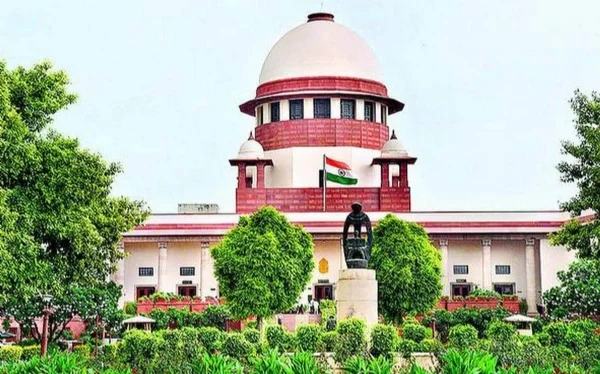
Gen Z Lawyers Association submits a 27-page representation to the Chief Justice of India! Invoking Article 14 of the Constitution, demands six months’ imprisonment for both political leaders, just as the law applies to ordinary citizens!
Association recalls that former Maharashtra Congress Cabinet Minister Swaroopsingh Naik was previously sentenced to one month’s imprisonment for contempt of court!
‘No matter how powerful a political leader may be, nobody is above the law!’ Association cites landmark Supreme Court judgments and demands that political leaders receive no preferential treatment.
Mumbai, October 16, 2026: A demand for stringent legal action against political leaders and influential individuals accused of repeatedly making serious allegations against the judiciary has gained momentum.
The Gen Z Lawyers Association has submitted a 27-page representation to the Chief Justice of India, seeking strict action concerning allegations of contempt of court against Congress leader Rahul Gandhi, Shiv Sena (Uddhav Balasaheb Thackeray) MP Sanjay Raut, journalist Nikhil Wagle and others.
In its representation dated October 16, the Association has relied upon several landmark Supreme Court judgments, contending that the practice of “first committing contempt of court, then tendering an apology and thereafter escaping consequences” must be brought to an end.
‘The Small Get Caught in the Net of Law While the Powerful Escape’ — Association Cites Supreme Court Judgments!
Referring to T.N. Godavarman Thirumulpad v. Ashok Khot, (2006) 5 SCC 1, the Association has emphasised the principle laid down by the Supreme Court:
“Whoever he may be, however high he is, he is under the law. No matter how powerful he is and how rich he may be.”
“THE LAW IS SUPREME.”
The Association has also relied upon National Human Rights Commission v. State, (2009) 6 SCC 767, questioning whether the law should operate in a manner where ordinary citizens are caught in its net while powerful and influential individuals manage to escape.
“One law for ordinary citizens and another for political leaders would offend the constitutional guarantee of equality under Article 14,” the Association has argued.
Sanjay Raut’s Statements an Attack on the Dignity of the Judiciary? ‘Calling Judges Brokers!’ Demand for Stringent Action!
Mumbai: Serious controversy has arisen over statements allegedly made by Shiv Sena (UBT) MP Sanjay Raut concerning the Indian judiciary.
The Gen Z Lawyers Association has alleged that making sweeping accusations against the judiciary, comparing courts to “Sulabh toilets”, and allegedly suggesting that serving and former Chief Justices should use the word “Dalal” (broker) instead of “Justice” constitute a direct attack on the dignity and institutional credibility of the judiciary.
In its representation to the Chief Justice of India, the Association has raised three principal allegations against Sanjay Raut.
First allegation: Allegedly asserting that the Indian judiciary functions under the influence or control of the ruling political party, thereby questioning the independence and impartiality of courts.
Second allegation: Allegedly comparing courts to “Sulabh toilets” and suggesting that no work gets done in courts without payment of money.
Third and most serious allegation: Allegedly suggesting that serving and former Chief Justices should use the designation “Dalal” instead of “Justice”, thereby portraying judicial officers as brokers rather than independent dispensers of justice.
“Criticising a judicial decision is one thing; portraying the entire judiciary as corrupt, purchasable and subservient to political power is altogether different. Freedom of expression cannot become a licence to destroy public confidence in the judiciary,” the Association has contended.
According to the representation, two contempt petitions have been filed against Sanjay Raut before the Principal Seat of the Bombay High Court, while contempt-related proceedings are also stated to be pending before its Aurangabad Bench.
The Association has called for examination of the original videos, transcripts of the alleged statements and relevant judicial orders.
“If an ordinary advocate or citizen commits serious contempt of court, the law takes its course. Why should Sanjay Raut receive different treatment merely because he is a Member of Parliament? If the law is equal for everyone, the dignity of the judiciary must prevail over political influence,” the Association has questioned.
Relying upon the Supreme Court decisions in In Re: S. Mulgaokar and L.D. Jaikwal, the Association has demanded that, if the allegations against Raut are established through evidence, the proceedings should not be concluded merely upon acceptance of a formal apology.
Instead, it has urged the Court to impose stringent and deterrent punishment, including imprisonment where legally warranted.
“Courts are not arenas for political mudslinging, and judges are not convenient targets for reckless political attacks. If serious attacks on the judiciary are proved, the law must take its course with full force,” the Association has asserted.
Supreme Court Had Clearly Warned Rahul Gandhi in 2019!
The Association has specifically referred to the contempt proceedings involving Rahul Gandhi arising from the Rafale controversy in 2019.
In Yashwant Sinha v. CBI, (2020) 2 SCC 338, the Supreme Court expressed serious displeasure over Rahul Gandhi’s attribution of statements to the Court that were not part of its judicial findings.
At the relevant time, Rahul Gandhi initially attempted to defend his statements. Subsequently, he tendered an unconditional apology, which the Supreme Court took into consideration while closing the contempt proceedings.
However, the Court made it clear that the Supreme Court or any other court should not be dragged into political controversies by attributing to it findings or conclusions that it had never recorded.
The Supreme Court expressly observed:
“Certainly Mr Gandhi needs to be more careful in future.”
The Association has now raised a pointed question:
“Once the Supreme Court has already issued an express warning, would it be appropriate to accept yet another formal apology if a subsequent act of serious and deliberate contempt is established?”
According to the Association, an apology offered merely as a device to avoid punishment should not automatically be accepted.
Where serious and wilful contempt is established, stringent punishment, including imprisonment where warranted under law, should follow.
Attention Drawn to the Supreme Court Order Dated October 15, 2026!
The Association has also referred to a Supreme Court order dated October 15, 2026.
According to the representation, notices were issued in W.P. (Civil) Nos. 1353/2026, 1351/2026 and 1356/2026, with the next date fixed for October 27, 2026.
The Association has further stated that, in W.P. (C) No. 1351/2026, the petition of Petitioner No. 6 was provisionally entertained subject to an explanation regarding his conduct.
In this background, the Association has sought a detailed examination of Rahul Gandhi’s alleged conduct.
The Association maintains that criticising a judicial judgment is a legitimate right, but making serious allegations against the integrity of judges without supporting evidence, in a manner that undermines public confidence in the judiciary, raises a different legal issue.
It has also demanded an evidence-based examination of statements and publications allegedly made by journalist Nikhil Wagle.
‘Slap, Say Sorry and Go Scot-Free’ Cannot Be Allowed!
The Association has relied upon L.D. Jaikwal v. State of U.P., (1984) 3 SCC 405, objecting to the practice of attempting to escape the consequences of serious contempt merely by tendering a formal apology.
“An apology must arise from genuine remorse. It should not become a legal weapon used merely to avoid punishment,” the Association has stated.
It has also cited the sixth consideration discussed in In Re: S. Mulgaokar, (1978) 3 SCC 339, contending that when attacks upon the judiciary cross the limits of what can reasonably be tolerated, the law must be enforced firmly.
Justice C.S. Karnan Was Sentenced to Six Months’ Imprisonment — Why Should Political Leaders Receive Different Treatment?
The Association has referred to the landmark decision in In Re: Justice C.S. Karnan, (2017) 7 SCC 1.
In that case, the Supreme Court sentenced a sitting High Court judge to six months’ imprisonment for contempt of court.
“If even a High Court judge can be punished for contempt, how can political leaders, Members of Parliament or influential journalists claim special protection merely because of their position or status?” the Association has questioned.
The Association has clarified that it is not demanding identical punishment in every case. Rather, its central argument is that the same legal standards must apply equally to everyone, as required by the Constitution.
Investigate the Role of Senior Advocates and Political Leaders Too!
The Association has also demanded examination of the roles of political leaders, organisers and legally trained individuals allegedly associated with the incidents involving Rahul Gandhi.
The representation refers to the alleged involvement of Abhishek Manu Singhvi, Kapil Sibal, D. K. Shivakumar and others.
However, mere presence at an event or political association does not, by itself, establish contempt of court. Actual participation or intentional assistance must be established through legally admissible evidence.
‘Respect the Judiciary or Face the Full Force of Law!’ — Association’s Warning
The Association has urged the Chief Justice of India to ensure an impartial examination of the allegations while granting all concerned persons a full opportunity of being heard.
It has demanded that, where serious and wilful contempt is established, courts should not be satisfied merely with a superficial or tactical apology.
Instead, appropriate and deterrent punishment, including imprisonment where warranted under Section 12 of the Contempt of Courts Act, 1971, should be imposed.
“Whether it is political power, the position of Leader of the Opposition, or influence in journalism — nobody is above the judiciary or the law. The authority of law must apply equally to ordinary citizens and the most powerful individuals in the country!”
This is the central message conveyed through the Association’s representation.
All eyes are now on what further action, if any, will follow before the Supreme Court in response to these demands.