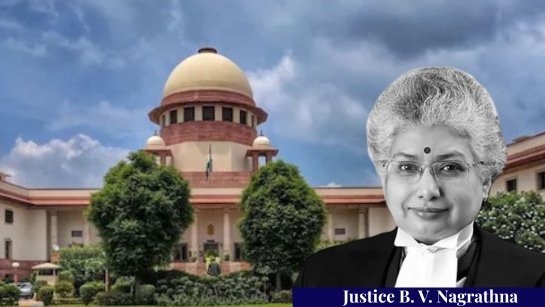
Court Records and Video Evidence Place the Justice Nagarathna Bench at the Centre of the Most Grave Allegation That Can Be Levelled Against a Court of Justice.
A poor father’s plea dismissed within minutes with a ₹1 lakh penalty, while a corporate giant’s petition—suffering from the same legal infirmity—was heard for days without any adverse consequences. Same Bench. Same ground. Starkly different treatment.
The Junior Advocates and Law Students Association, along with Human Rights Activists, have submitted a formal complaint against Justices Smt. B. V. Nagarathna and Sh. R. Mahadevan, alleging violation of Articles 14 and 39-A of the Constitution of India and arbitrary, discriminatory and unequal treatment.
New Delhi, March 1, 2026
In what is being described as a textbook illustration of two-tier justice, a formal complaint backed by court records and video recordings has been placed before the Chief Justice of India alleging that a Supreme Court bench delivered diametrically opposite treatment to two sets of litigants who appeared before it on the very same legal ground — with the difference in treatment tracking, with uncomfortable precision, the difference in their wealth and the seniority of the advocates who represented them.
On one side of the divide: a poor father, accompanied by a junior advocate, who had come to the highest court in the land seeking nothing more than school admission for his daughters under the Right to Education Act. On the other: a powerful corporate entity represented by some of the most celebrated — and expensive — names at the Supreme Court Bar, contesting a dispute worth over Rs. 400 crores.
The bench, comprising Justice B.V. Nagarathna and Justice R. Mahadevan, dismissed both petitions on the identical ground of non-maintainability. Everything else about how the two matters were handled, however, was different in ways that the complaint — filed by the Junior Advocates and Law Students Association along with human rights activists — describes as a naked violation of Articles 14 and 39A of the Constitution of India and Article 14 of the International Covenant on Civil and Political Rights.
The Poor Father and the Junior Advocate: Silenced, Penalised, Humiliated
Writ Petition (Civil) No. 1302 of 2025, United Voice For Education Forum v. Union of India, was not a petition about money. It was a father’s plea — modest in its ask, urgent in its human stakes — for his daughters’ right to free education. He could not afford a senior advocate. He came with a junior lawyer, as millions of ordinary Indians must when they approach the courts.
The bench, according to the complaint, did not permit the junior advocate to argue the matter on merits at all. The petitioner and his counsel were allegedly scolded, threatened, insulted, and humiliated before an open court. When the order came — dated December 12, 2025 — it dismissed the petition with costs of Rs. 1 lakh. Not a single word of the junior advocate’s submissions or the petitioner’s grounds found its way into the order. It was as though they had never spoken.
For a poor family, Rs. 1 lakh is not a fine. It is a catastrophe.
The father returned to court, this time with a Miscellaneous Application. He tendered an unconditional apology. He pleaded his financial destitution. He asked only for mercy. The law, it turns out, was on his side: the Supreme Court’s own ruling in N. Peddi Raju, In Re, 2025 SCC OnLine SC 1694, had held that courts must ordinarily accept genuine apologies, observing that “the majesty of law lies not in punishing someone, but in forgiving someone who acknowledges their mistake.”
The bench, the video recording proves, did not record his apology. It noted incorrect facts. It dismissed the application — and warned him against approaching the court again. A poor man who had come seeking justice for his daughters left court, on each occasion, more burdened than when he arrived.
The Corporate Giants and the Senior Advocates: Heard at Length, Spared All Consequence
The contrast that follows is, the complaint argues, impossible to explain on any principled basis.
In Torrent Power Ltd. v. Ashish Rathi, Civil Appeal No. 11746 of 2024, the same bench confronted a petition involving over Rs. 400 crores. It found — just as it had in the poor father’s case — that the petition was not maintainable in view of binding Supreme Court precedents. It went further: it found that the petition was a calculated attempt to delay proceedings and strategically obstruct outcomes at the expense of other stakeholders. In ordinary language, it found the petition to be an abuse of process.
But the advocates on the other side of the Bar were not junior lawyers making a first appearance. They were Dr. Abhishek Manu Singhvi and Mr. Kapil Sibal — holders of the coveted Senior Advocate designation, commanding fees that dwarf the annual income of most Indian families, and long accustomed to the deference that the highest courts in the land have traditionally extended to those who wear the black band of seniority.
They were heard. At length. Over several days. Their arguments — arguments that the bench would ultimately find to be contrary to binding precedent, arguments that the complaint characterises as having been made in full knowledge of the Supreme Court judgments that overruled them — were recorded in careful detail in the order. The bench treated them with the patience and dignity that, the complaint bitterly notes, was entirely absent when a junior advocate stood up to speak for a poor father.
And when it came to costs? The bench — which had just found the petition frivolous, dilatory, and an instrument of strategic obstruction — inserted a single line into its order: it “refrained” from imposing costs. No action of contempt against the senior advocates. No reference to the Bar Council of India. No question of disciplinary proceedings or the withdrawal of senior designations. Nothing.
The Law That Was Not Applied
The complaint does not merely allege unfairness in the abstract. It sets out, with chapter and verse, the legal obligations that the bench was bound to discharge in the corporate matter and did not.
Where senior advocates advance arguments already overruled by binding precedent — and do so, it is alleged, while suppressing those precedents from the court — the bench is not merely empowered but required, under a substantial body of Supreme Court and High Court authority, to impose heavy costs, record the professional misconduct, initiate contempt proceedings, forward a disciplinary reference to the Bar Council of India, and take steps for the withdrawal of the Senior Advocate designation. The relevant precedents cited in the complaint include
Kusha Duruka v. State of Odisha, (2024) 4 SCC 432; E.S. Reddi v. Chief Secretary, Govt. of A.P., (1987) 3 SCC 258; Lal Bahadur Gautam v. State of U.P., (2019) 6 SCC 441; State of Orissa v. Nalinikanta Muduli, (2004) 7 SCC 19; Sajid Khan Moyal v. State of Rajasthan, 2014 SCC OnLine Raj 1450; R.K. Anand v. Delhi High Court, (2013) 1 SCC 218; Court on its own motion v. State, 2008 SCC OnLine Del 965; Suo Motu v. Yatin Narendra Oza, 2020 SCC OnLine Guj 1525; M. Veerbhadra Rao v. Tek Chand, AIR 1985 SC 28; Hindustan Organic Chemicals Ltd. v. ICI India Ltd., 2017 SCC OnLine Bom 74.
None of this was done. Instead, two of the most powerful advocates in the country walked out of court without a word of censure, having consumed days of the Supreme Court’s time arguing a case the bench itself found to be an abuse of process.
“The Scales Were Not Blind”
The constitutional framework within which this complaint is situated is not obscure. Article 14 guarantees equality before the law — not equality in name, but equality in fact, equality in the courtroom, equality in how the powerful and the powerless are treated when they stand before the same bench on the same question. Article 39A, a directive principle of constitutional weight, mandates equal justice and free legal aid, recognising that formal access to courts means nothing if the quality of justice dispensed within them varies with the depth of one’s pocket.
In Harisingh v. State of Haryana, 1993 (66) ELT 23 (SC), it held that like cases must be decided alike — that the rule of law demands consistency, and that inconsistency in the face of identical facts is not merely error but a form of institutional injustice.
As the complaint puts it with quiet devastation: “The scales were calibrated not by law, but by the wealth and seniority of those who appeared before the court.”
A Systemic Warning
What lends particular gravity to this complaint is not merely what happened in two individual cases, but what those cases, taken together, signal. Junior advocates across the country — many of them struggling to establish themselves, many of them the sole hope of clients who cannot afford the luxury of a senior retainer — are watching. Law students are watching. The millions of ordinary Indians who will one day need to approach a court are watching.
If the implicit message from the highest court in the land is that seniority at the Bar confers immunity from judicial censure, and that poverty at the Bar confers vulnerability to judicial rebuke, then the promise of equal justice is not merely unfulfilled — it is being actively undermined from the institution that is supposed to be its last guardian.
The Junior Advocates and Law Students Association has urged the Chief Justice of India and the President of India to order an immediate inquiry, to ensure relief for the poor father whose unconditional apology was left unrecorded, and to take institutional steps to ensure that what is alleged to have occurred before this bench never occurs again.
The court records and video recordings, the complaint notes, are available. The evidence, it says, speaks for itself.
The Court Under Public Scrutiny
The Allahabad High Court, in Nanha S/o Nabhan Khan v. State of U.P., 1992 SCC OnLine All 871, articulated a truth that bears urgent repetition in the present context:
“In a democracy the judiciary, like any other State organ, is under scrutiny of the public and rightly so, because the people are the ultimate masters of the country and all State organs are meant to serve the people. Hence the people will feel disappointed and dismayed if courts give contrary decisions on the same facts. The public, whose interests all judicial and quasi-judicial authorities ultimately have to serve, will get a poor impression of a court which delivers contrary decisions on identical facts.”
The court further invoked the celebrated observation of Alexis de Tocqueville — that a man’s passion for equality is greater than his desire for liberty — and grounded it in the constitutional text itself, noting that the Preamble of the Constitution records the solemn resolve of the people of India to secure to all citizens, amongst other things, equality of status and opportunity. The principle of equality, the court held, is not a peripheral guarantee — it is one of the basic attributes of Indian citizenship.
These words acquire a particular and painful resonance when read against the facts of the present complaint. A poor father and his junior advocate were denied the opportunity to be heard, penalised with costs that for them represented financial ruin, and subjected to treatment that the complaint describes as humiliating and degrading. On the very same legal ground, before the very same bench, powerful corporates represented by the most eminent Senior Advocates in the country were heard at length, treated with deference, and spared every consequence that the law required to be visited upon them. If there is a clearer illustration of contrary decisions on identical facts — with the difference tracking, precisely and painfully, the difference in wealth and seniority — it is difficult to imagine one.
The Supreme Court has also observed, in terms that admit of no ambiguity, that there is an imperative need to minimise the scope for arbitrary exercise of power in all walks of life. It is neither wise nor constitutionally permissible, the Court has said, to depend on the good sense of individuals, however high the office they occupy. The precious rights of citizens — to life, liberty, property, and equal justice — cannot be exposed to the vagaries of individual whim and fancy. High seats of power do not, by themselves, confer wisdom or impartiality upon those who occupy them. It is precisely because this is so that the Constitution erected the guarantee of equality as a check upon all power — judicial power included.
When that guarantee is honoured in the breach — when one measure of justice is applied to those who can afford Senior Advocates, and another to those who cannot — the institution does not merely fail the individual litigant. It fails the democratic ideal upon which its own authority rests.
In NOIDA Entrepreneurs Assn. v. NOIDA, (2011) 6 SCC 508, the Supreme Court articulated the foundational principle with clarity: every holder of public office is a trustee of the people in whom sovereignty vests. All power is held in trust for public good. State action must be non-arbitrary and must satisfy the touchstone of Article 14. It must conform to principle, be governed by reason and relevance, and must neither suggest discrimination nor give even the appearance of bias, favouritism, or nepotism. A decision taken without principle or rule is unpredictable, and such unpredictability is the very antithesis of the rule of law. The Public Trust Doctrine, rooted in Article 21, renders any action vitiated by lack of bona fides a mere colourable exercise of power. As the Court declared: “The Rule of Law is the foundation of a democratic society.”
The scope of these obligations was further elaborated in Suman Gupta v. State of J&K, [1983] 3 SCR 985, where the Supreme Court held that every exercise of administrative or judicial power must be structured within a system of controls governed by two indispensable tests: relevance — in relation to the object the power seeks to serve — and reason — in regard to the manner in which it is exercised. Drawing from the constitutional watershed of Maneka Gandhi v. Union of India, the Court reaffirmed that Article 14 is violated by powers and procedures that in themselves produce unfairness and arbitrariness. Our entire constitutional order is founded upon the rule of law, and within such an order it is impossible to conceive of any legitimate power that is arbitrary in character or travels beyond the bounds of reason.
Measured against these standards, the conduct complained of cannot withstand scrutiny. When the same bench, on the same legal ground, silences the poor and punishes them with costs while extending patience, dignity, and detailed engagement to the wealthy — the rule of law is not merely bent; it is broken.