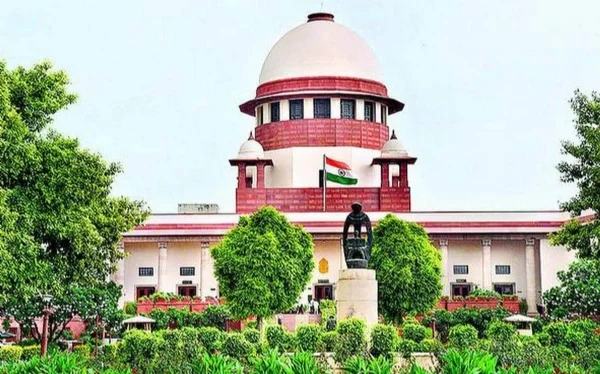
New Delhi: The Indian Bar Association (IBA) and the Rashtriya Samvidhan Raksha Samiti (RSRS), through their Chairman Advocate Nilesh Ojha, have filed a detailed representation before the National Human Rights Commission (NHRC) alleging that the arrest, investigation and judicial remand of two law students, Prabal Pratap Singh and Chander Bhan, are contrary to the Constitution, the statutory scheme enacted by Parliament, and the binding law declared by the Supreme Court.
The representation seeks the immediate release of both students from judicial custody, compensation for the alleged violation of their fundamental rights under Articles 14 and 21 of the Constitution, and appropriate legal action against the police officers, the Public Prosecutor and the concerned Magistrate for their respective roles in the matter.
The controversy arises out of an incident that allegedly took place inside the Supreme Court during proceedings before a Bench comprising Justice K.V. Viswanathan and Justice Alok Aradhe. According to publicly reported facts, Prabal Pratap Singh, who was appearing in person, allegedly threw papers inside the courtroom and made objectionable remarks against the Chief Justice of India. The representation, however, notes that despite the alleged misconduct, the Bench exercised judicial restraint and did not invoke its contempt jurisdiction or direct prosecution under the special statutory procedure prescribed for offences committed in the face of the Court. Subsequently, the Delhi Police independently registered an FIR and arrested both students.
The representation expressly clarifies that the alleged conduct attributed to Mr. Prabal Pratap, if established, deserves unequivocal condemnation and cannot be justified or defended. At the same time, it points out that the Hon’ble Supreme Court Bench before whom the incident allegedly occurred exercised judicial restraint and did not invoke its contempt jurisdiction or direct prosecution under the special statutory procedure. The representation contends that, in these circumstances, any subsequent independent action by the police required strict authority under the statutory scheme enacted by Parliament and was required to conform to the procedure prescribed by law.
The representation further emphasises that an accused person does not lose his constitutional or statutory rights merely because allegations have been made against him. However grave the accusation may be, it does not confer a licence upon the police or any other State authority to disregard the procedure established by law or violate the fundamental rights guaranteed under the Constitution. According to the representation, the Rule of Law demands that every accused, irrespective of the nature of the allegations, be dealt with strictly in accordance with the Constitution and the procedure prescribed by Parliament, for constitutional safeguards exist precisely to protect liberty in difficult and unpopular cases as much as in ordinary ones.
The representation further notes that despite the alleged misconduct, the Bench exercised judicial restraint and did not invoke its contempt jurisdiction or direct prosecution under the special statutory procedure governing offences committed in the face of the Court. According to the representation, the Delhi Police thereafter independently registered an FIR and arrested both students.
According to the representation, this course of action is contrary to the statutory scheme enacted by Parliament. It submits that where an alleged offence is committed during judicial proceedings in the presence of a Court, prosecution can proceed only through the special mechanism prescribed under Section 267 of the Bharatiya Nyaya Sanhita, 2023, read with Sections 215, 384 and 385 of the Bharatiya Nagarik Suraksha Sanhita, 2023, and not through an independent FIR registered by the police. Since the Supreme Court Bench itself neither initiated contempt proceedings nor directed prosecution under the special statutory procedure, the representation contends that the police lacked authority to bypass that procedure by invoking the ordinary criminal process.
In the representation, it has been pointed out that in several similar cases the Supreme Court has quashed FIRs registered in violation of mandatory statutory safeguards and, in appropriate cases, has also awarded compensation to the accused. The representation relies upon a series of binding judgments holding that where Parliament has prescribed a special statutory procedure for initiating prosecution, it cannot be bypassed by invoking different penal provisions. In Dr. S. Dutt v. State of Uttar Pradesh, AIR 1966 SC 523, the Supreme Court held that the prosecution cannot evade the mandatory requirement of a complaint by deliberately omitting the relevant offence and prosecuting the accused under some other provision. The same principle was reiterated in C. Muniappan v. State of Tamil Nadu, (2010) 9 SCC 567, and consistently followed in Shrinath Gangadhar Giram v. State of Maharashtra, 2017 SCC OnLine Bom 10118, and State of Haryana v. Shagun, 2024 SCC OnLine P&H 1, held that where the statute requires a complaint by the competent authority, an FIR cannot substitute that mandatory requirement and proceedings initiated in violation thereof are liable to be quashed and cost imposed upon state.
A substantial part of the representation deals with the constitutional duties of the Public Prosecutor. Relying upon the Constitution Bench judgment in Sheonandan Paswan v. State of Bihar and several subsequent decisions of the Supreme Court, the representation submits that a Public Prosecutor is an Officer of the Court and a Minister of Justice, not merely a representative of the Government or the investigating agency. His foremost duty is to assist the Court by placing the correct facts, the correct statutory provisions and the correct legal position before it. Even where the defence fails to cite a binding precedent or statutory safeguard, the Public Prosecutor remains duty-bound to bring the correct law to the notice of the Court and prevent any unlawful deprivation of personal liberty.
The representation also relies upon the recent Supreme Court judgment in Dr. Manoj Kumar Rawat v. State of Uttar Pradesh, wherein the Court reiterated that State authorities and Government law officers are expected to render genuine assistance to the Court by placing the correct factual and legal position on record, and are not expected to defend actions contrary to settled law or support a case by filing affidavits inconsistent with the applicable legal position.
The representation further submits that the remanding Magistrate also bears an independent constitutional responsibility to safeguard personal liberty. It states that the Supreme Court has consistently held that a Magistrate is not a mere post office for the investigating agency. Before authorising judicial custody, the Magistrate must independently satisfy himself that the arrest is lawful, that the investigation has been initiated in accordance with the procedure established by law, that the investigating agency possesses jurisdiction, and that all mandatory statutory safeguards have been complied with. According to the representation, where the arrest itself is contrary to law, the Magistrate is duty-bound to protect the liberty of the citizen rather than mechanically authorising further detention.
The representation therefore alleges that the continued judicial custody of the two law students constitutes a continuing violation of their fundamental rights under Articles 14 and 21 of the Constitution.
Before the NHRC, the Indian Bar Association and Rashtriya Samvidhan Raksha Samiti have sought an independent inquiry into the conduct of the police officials, the Public Prosecutor and the concerned Magistrate, together with appropriate legal action against those found responsible for the alleged unlawful arrest and detention.
The representation also seeks constitutional compensation for both law students by relying upon the Supreme Court’s decisions in S. Nambi Narayanan v. Siby Mathews, Rini Johar v. State of Madhya Pradesh, and Mahabir v. State of Haryana. It submits that where a citizen is deprived of personal liberty otherwise than in accordance with the procedure established by law, constitutional courts have consistently recognised the right to public law compensation, with liberty to recover the amount from the officials responsible for the violation.
According to the organisations, the case transcends the individual grievance of two law students. It raises fundamental constitutional questions concerning the Rule of Law, judicial independence, the limits of police powers, prosecutorial fairness, judicial oversight during remand proceedings, and the constitutional guarantee that no person shall be deprived of personal liberty except in accordance with the procedure established by law. They contend that permitting the statutory safeguards enacted by Parliament for incidents occurring before constitutional courts to be bypassed through the ordinary criminal process would have far-reaching consequences for civil liberties and the administration of justice.
The representation further states that it is not founded upon abstract legal propositions but is supported by an extensive body of binding Supreme Court precedents dealing with illegal arrests, unlawful prosecutions and arbitrary deprivation of personal liberty. According to the representation, in several cases the Supreme Court has quashed criminal proceedings and FIRs initiated contrary to the procedure established by law, strongly deprecated the conduct of investigating agencies, reminded Public Prosecutors of their obligation to assist the Court fairly and independently, and censured Magistrates for mechanically authorising detention without examining the legality of the arrest or the jurisdiction of the investigating agency. The representation also refers to decisions in which the Supreme Court has directed disciplinary or other appropriate action against erring officials, initiated or recommended proceedings where warranted, and awarded constitutional compensation in writ jurisdiction to persons whose fundamental rights under Articles 14 and 21 were violated by unlawful arrest or detention, while granting liberty to the State to recover the compensation from the officers found responsible for the illegal acts. It is on the strength of these binding precedents that the present representation seeks similar reliefs from the National Human Rights Commission.