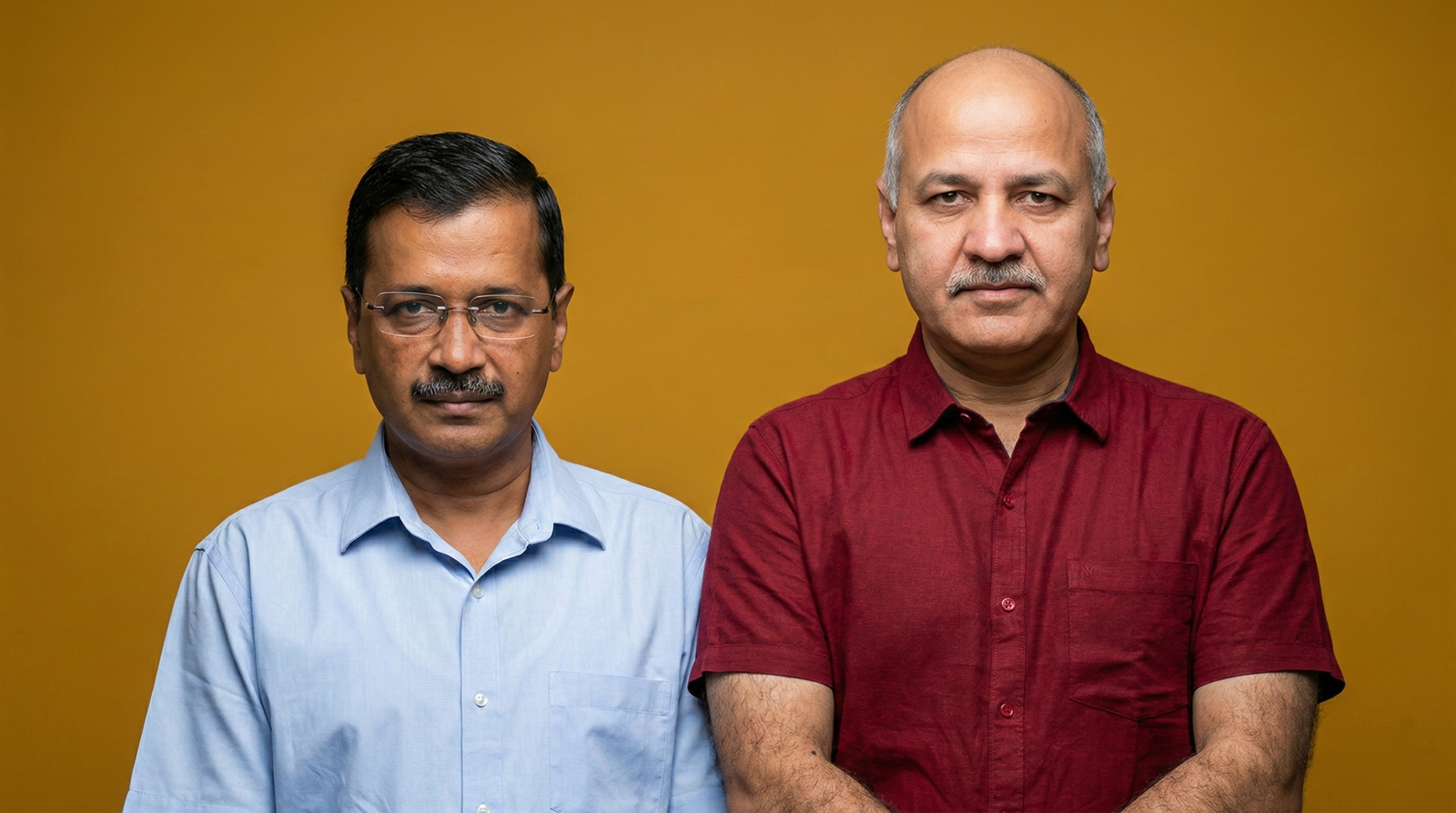
The discharge order dated 27.02.2026 by the Delhi Rose Avenue Court is stated to be in direct conflict with the findings of the Hon’ble Supreme Court and the Delhi High Court. In Manish Sisodia v. CBI, 2023 SCC OnLine SC 1393, the Hon’ble Supreme Court specifically observed that sufficient material existed against Arvind Kejriwal, Manish Sisodia, and other accused persons, and held that the defence could be properly examined only after evidence is led during trial, while declining bail in view of the availability of strong material evidence against them. However, in a development which are shocking, the trial court — which is much subordinate to the Supreme Court — discharged all 23 accused on the ground that there was no evidence and that the case was not fit for trial.
The complaint has been filed by the Indian Lawyers and Human Rights Activists Association and the Supreme Court and High Court Litigants Association through its Vice-President, Mr. Mursalin Sheikh. The complainant is going to represented by Adv. Nilesh Ojha, National President of the Indian Bar Association and Rashtriya Sanvidhan Raksha Samiti.
Action has been sought under Sections 256, 257 and 198 of the Bharatiya Nyaya Sanhita (BNS), Sections 2(b), 12 and 16 of the Contempt of Courts Act, 1971, and Section 7-A of the Prevention of Corruption Act, along with disciplinary action including immediate suspension and dismissal from judicial service.
In the recent judgment in Nirbhay Singh Suliya v. State of M.P., 2026 SCC OnLine SC 8, the Supreme Court has clarified that where allegations or complaints against a judicial officer are found to be substantiated, the High Court is not only empowered but duty-bound to take appropriate disciplinary action and, also to direct initiation of criminal prosecution in accordance with law.
It is alleged that the impugned discharge order is in direct conflict with binding findings recorded by superior courts, including the Hon’ble Supreme Court and the Hon’ble Delhi High Court, on substantially the same material. In particular, reliance has been placed on the judgment dated 30.10.2023 in Manish Sisodia v. CBI, 2023 SCC OnLine SC 1393, wherein the Hon’ble Supreme Court observed that there existed sufficient material indicating involvement of several accused persons, including Arvind Kejriwal, and held that the defence of the accused could be appropriately examined only after evidence is led during trial. Considering the gravity of the allegations and the stage of the proceedings, the Supreme Court declined to grant bail to Manish Sisodiya.
Subsequently, the Hon’ble Delhi High Court, in its order dated 9 April 2024 in Arvind Kejriwal v. Directorate of Enforcement (2024 DHC 2851), which was based on substantially the same material, observed the existence of sufficient material indicating corruption and alleged kickbacks, establishing a prima facie connection of Arvind Kejriwal with the alleged offences. The High Court further noted allegations that proceeds of crime exceeding ₹100 crores were utilized by the Aam Aadmi Party in the Goa Assembly elections. Said findings are not disturbed by the Supreme Court rather earlier findings in Manish Sisodia v. CBI, 2023 SCC OnLine SC 1393, are reaffirmed in Arvind Kejriwal Vs Directorate of Enforcement (2025) 2 SCC 248.
The complaint contends that, notwithstanding these prior judicial findings by superior courts, the impugned discharge order passed by the subordinate Sessions Court departs from and contradicts such findings without adequate legal justification.
It is further alleged that, in a shocking development, the Sessions Judge granted a clean discharge to all 23 accused persons despite the existence of judicial observations indicating substantial incriminating material on record.
The Supreme Court has repeatedly held that at the stage of discharge, a trial court is only required to examine whether a prima facie case exists and not to conduct a detailed evaluation of evidence. In Dipakbhai Jagdishchandra Patel v. State of Gujarat (2019) and Asim Shariff v. NIA (2019), the Court clarified that if the material on record raises a strong suspicion of the accused’s involvement, charges must be framed and the matter should proceed to trial. The Court also cautioned that a “mini-trial” or meticulous weighing of evidence at this preliminary stage is impermissible, as questions regarding credibility and guilt can be decided only after full evidence is led during trial.
Violation of Settled Law on Criminal Conspiracy
The complaint further contends that the impugned order stands in direct conflict with the Supreme Court’s own findings and well-settled legal principles governing criminal conspiracy under Section 120-B of the Indian Penal Code.
Notably, the Supreme Court had itself already recorded findings indicative of a conspiracy in the Delhi Excise Policy matter and direct involvement of Arvind Kejriwal and others. Yet, the Sessions Judge, in a striking departure from these findings, held that no proof of conspiracy had been established — a conclusion the complaint characterizes as both legally untenable and judicially perverse.
The impugned order is alleged to violate binding precedents, including Pratapbhai Solanki v. State of Gujarat (2013) 1 SCC 613,— in which the Supreme Court authoritatively held that direct evidence of conspiracy is not required, and that conspiracy may legitimately be inferred from Circumstantial evidence and Conduct of the accused.
In Raman Lal vs State 2001 Cr L J 800, it is ruled that;
“In Shivnarayan Laxminarayan Joshi & Ors. vs. State of Maharashtra , the Apex Court held that since it is impossible to adduce direct evidence of conspiracy, the offence can only be proved largely from the inference drawn from acts or illegal omissions committed by the conspirators in furtherance of a common design. Once such a conspiracy is proved, act of one conspirator becomes the act of the others. A co-conspirator, who joins subsequently and commits overt-acts in furtherance of the conspiracy, must also be held liable.”
This ruling reinforces a fundamental and long-settled principle of criminal law: the absence of direct evidence cannot, by itself, be a ground for discharge in a conspiracy case. The law explicitly recognises that:
- Conspiracy, by its very nature, is hatched in secrecy and cannot ordinarily be proved through direct evidence
- Guilt may be established through inference drawn from overt acts, omissions, and conduct of the accused
- Once conspiracy is established, the act of each conspirator is attributable to all — including those who join the conspiracy at a later stage
The complaint contends that the Sessions Judge’s order, by demanding direct and foundational proof against each of the 23 accused individually, ignored this settled legal position entirely — thereby acting contrary to a consistent line of Supreme Court authority and committing what the complaint terms a willful and deliberate departure from binding precedent.
The complaint accordingly contends that the judicial officer is guilty of contempt of court and has acted with legal malice — rendering the impugned order not merely erroneous, but a deliberate subversion of constitutional and legal authority.
In view of the above, a formal representation has been submitted to the Hon’ble President of India seeking urgent intervention and issuance of appropriate directions to the Central Bureau of Investigation (CBI) and the Solicitor General of India for initiating action against Shri Jitendra Singh, Special Judge (MP/MLA Cases), Rouse Avenue Court, New Delhi.
The representation alleges “gross criminal misconduct” in connection with the order dated 27 February 2026, by which multiple accused — including prominent political figures — were discharged in the multi-crore Delhi Excise Policy case.
The complaint calls for proceedings under several statutory provisions, including:
- Sections 256, 257, and 198 of the Bharatiya Nyaya Sanhita (BNS), relating to public servants which includes Judges acting contrary to law and abuse of official authority
- Sections 2(b), 12, and 16 of the Contempt of Courts Act, 1971, pertaining to civil contempt and punishment for wilful disobedience of binding judicial precedents by any Judge.
- Section 7-A of the Prevention of Corruption Act, concerning offences involving abuse of position and corrupt conduct
In addition, the representation seeks immediate suspension of the concerned judicial officer pending inquiry, followed by appropriate disciplinary proceedings, including dismissal from service in accordance with law, should the allegations be substantiated after due process.
The Supreme Courts various judgments made it clear that judicial office does not confer immunity from accountability, and that misconduct, abuse of authority, or actions contrary to law must be addressed through appropriate institutional mechanisms to preserve public confidence in the justice delivery system.
According to the representation, the impugned order arose from CBI Case No. 56 of 2022 (CBI vs. Kuldeep Singh & Others), relating to alleged irregularities and corruption in the formulation and implementation of the now-scrapped liquor policy. The complainant contends that the trial court’s decision to discharge all 23 accused persons was passed “in deliberate disregard of material evidence on record” and contrary to findings previously noted by the Delhi High Court in proceedings connected with money-laundering allegations.
Allegations of Ignoring Prima Facie Evidence
The complaint asserts that the Special Judge held no prima facie case existed for framing charges, observing that the prosecution’s material did not meet the legal threshold for trial and that allegations of a coordinated criminal conspiracy were unsupported by documentary proof. The order reportedly concluded that the case relied largely on assumptions, conjecture, or inferences rather than concrete evidence, and that no direct link between the accused and any illegal act had been established.
The complaint specifically points out that similar evidentiary material had earlier been examined by the Delhi High Court and Supreme Court and specific findings were given about the sufficient material Arvind Kejriwal and Manish Sisodia and others. In Manish Sisodia vs CBI 2023 SCC OnLine SC 1393, Supreme Court, specifically mentioned that the defence of manish Sisodia can be seen after evidence are led during trial
Delhi High Court in April 2024 while dealing with the case of Arvind Kejriwal v. Directorate of Enforcement (2024 DHC 2851). In that matter, the High Court had noted statements and financial trails allegedly indicating receipt and utilization of illicit funds connected with the excise policy investigation, including alleged use of funds in election campaigns.
Reference to High Court Observations
Citing specific paragraphs from the High Court’s order, the complaint highlights references to witness statements, alleged kickbacks, hawala transfers, and purported utilization of proceeds of crime. It claims that these findings were never set aside on merits by the Supreme Court, which later granted bail to the accused on grounds unrelated to the existence of prima facie evidence.
On this basis, the representation alleges that the discharge order “effectively nullifies binding findings of a superior court” and violates principles of judicial hierarchy.
It further argues that subordinate courts are bound by determinations of superior courts under Article 141 of the Constitution, and that any order passed “in the teeth of such findings” undermines constitutional discipline and the rule of law.
Legal Precedents Cited
The representation refers to past judicial actions where disciplinary proceedings were recommended against judges for allegedly improper discharge orders. Among them is a Madhya Pradesh High Court decision directing consideration of action against a Sessions Judge for discharging an accused without adequate consideration of facts.
This is not a novel proposition. It is firmly established by a substantial body of binding authority. In Roop Singh Parihar v. State of M.P., 2025 SCC OnLine MP 7184, the High Court of Madhya Pradesh, confronted with a Sessions Judge who had discharged an accused from serious offences without consideration of the facts of the case — manifestly to confer upon the accused the collateral benefit— directed that a copy of its order be placed before the Chief Justice for the initiation of disciplinary inquiry and action against the concerned judge. In State of Maharashtra v. R.A. Khan, 1992 SCC OnLine Bom 368; such Judge was convicted under Contempt.
In a similar misconduct by the Sessions judge action was ordered against him for discharging the accused in serious charges. In the case of Roop Singh Parihar v. State of M.P., 2025 SCC OnLine MP 7184 it is ruled as under;
“11. A copy of this order be sent to the Principal Registrar (Vigilance), High Court of Madhya Pradesh, Principal Seat, Jabalpur and to put up the same before the Hon’ble Chief Justice, High Court of Madhya Pradesh seeking permission for conducting an inquiry and for taking disciplinary action against Ist Additional Sessions Judge (Shri Vivek Sharma), Shivpuri who had discharged the present applicant from the offences punishable under Sections 409, 420, 467, 468, 471, 120-B and 107 of IPC without considering the facts of the case and to give undue advantage to the applicant to get benefit of bail. Therefore, it appears that Ist Additional Sessions Judge has ulterior motive in holding charge under Section 406 of IPC only against the applicant to give undue advantage to him by which applicant can avail the benefit of bail.”
There are other judgments on this point which attracts the provisions of Sec 218, 219, 166 etc of IPC. – Kodali Ramchandra Rao, AIR 1975 SC 1925. R.R. Parekh v. High Court of Gujarat, (2016) 14 SCC 1, Union of India v. K.K. Dhawan, (1993) 2 SCC 56, Rakesh Kumar Chhabra v. State of H.P., 2012 Cr.L.J. 354 (HP); Hurdut Surma, (1967) 8 WR (Cr.) 68; Biraja Prosad Rao v. Nagendra Nath, (1985) 1 Crimes 446 (Ori.); Anverkhan Mahamad Khan v. Emperor, 1921 SCC OnLine Bom 126; and N. Bhargavan Pillai v. State of Kerala, (2004) 13 SCC 217.
It is a settled principle of law that a judicial officer who knowingly acts in wilful disregard of binding precedents and material evidence on record, and thereby passes an order contrary to law for extraneous or improper considerations, may attract serious legal consequences. Such consequences can, in appropriate cases, include proceedings for contempt of court, action under applicable penal provisions, and departmental or disciplinary proceedings in accordance with the constitutional framework governing the judiciary.
Indian jurisprudence recognises that while judges enjoy functional independence and protection for bona fide judicial acts, this protection does not extend to acts tainted by corruption, mala fides, or conduct wholly outside the scope of lawful judicial authority. In proven cases of misconduct, disciplinary action — including removal from service through the prescribed constitutional process — may be initiated by the competent authority.
Historical instances have also demonstrated that judicial officers found guilty of corruption or abuse of office have faced prosecution and punishment under criminal law, in addition to service consequences. The case of Justice Shameet Mukherjee of the Delhi High Court, who was arrested and prosecuted for the allegations of accepting bribe of lakhs of rupees and also accepting favour of woman and wine to pass a favourable order, is often cited as an example that judicial office does not confer immunity from criminal accountability where wrongdoing is established through due process.
The relevant binding precedents and authorities governing these principles are set out below:-
Smt. Prabha Sharma Vs. Sunil Goyal and Ors. (2017) 11 SCC 77 New Delhi Municipal Council Vs. M/S Prominent Hotels Limited 2015 SCC Online Del 11910 ; Vijay Shekhar v. Union of India, (2004) 4 SCC 666; Shikhar Chemicals v. State of U.P., 2025 SCC OnLine SC 1653; Govind Mehta Vs State AIR 1971 SC 1708 , Shrirang Yadavrao Waghmare v. State, (2019) 9 SCC 144; Muzaffar Husain v. State, 2022 SCC OnLine SC 567; S.P. Gupta v. Union of India, 1981 Supp SCC 87; Supdt. of Central Excise v. Somabhai Ranchhodhbhai Patel, (2001) 5 SCC 65; State Bank of Travancore v. Mathew K.C., (2018) 3 SCC 85; Tata Mohan Rao v. S. Venkateswarlu, 2025 INSC 678; R.R. Parekh v. High Court of Gujarat, (2016) 14 SCC 1; Harish Arora v. Deputy Registrar, 2025 SCC OnLine Bom 2853, K. Ram Reddy v. State of A.P., 1997 SCC OnLine AP 1210, Sama Aruna v. State of Telangana, (2018) 12 SCC 150.