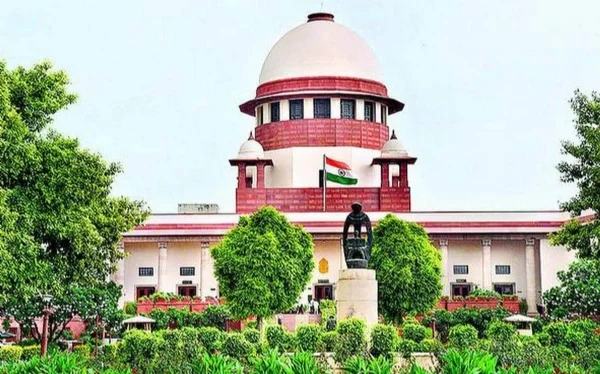
The interim order passed by the Hon’ble Supreme Court in relation to the Jantar Mantar protest is a welcome step towards safeguarding the constitutional rights of peaceful protestors while ensuring that the investigation into the registered FIRs continues unhindered. The directions issued by the Court strike an appropriate balance between protecting civil liberties and permitting investigating agencies to proceed with the investigation in accordance with law.
The Gen Z Lawyers Association and the Indian Bar Association welcome the interim directions issued by the Hon’ble Supreme Court. At the same time, as a suggestion in aid of constitutional jurisprudence, the Associations believe that one expression employed in the interim directions may merit reconsideration to avoid any unintended consequences in its implementation.
Instead of denying protection to all persons having “criminal antecedents,” it is suggested that the exclusion may be confined to “protesting students who are involved in any violent or unlawful act” or “persons who are prima facie found to have actively participated in any serious criminal overt act.” Such a formulation would more accurately balance the interests of justice with the constitutional rights guaranteed under Articles 14, 19 and 21 of the Constitution.
The Supreme Court’s Interim Directions
A Bench of the Hon’ble Supreme Court headed by the Hon’ble Chief Justice of India, Justice Surya Kant, by its order dated 28.07.2026 in Writ Petition (Criminal) No. 280 of 2026, Shailendra Mani Tripathi v. Union of India & Ors., granted the following interim reliefs which read thus;
“8. As an interim measure, we deem it appropriate to issue the following directions:
(i) Although it has already been stated at the Bar by the learned Solicitor General of India, on instructions, we also, as an abundant precaution, direct that all CCTV footage, drone footage, body-worn camera recordings, videography, wireless communication records, and PCR log collections related to the students’ protest be preserved.
(ii) The respondent(s) and police authorities shall ensure that the personal information and digital data of the protestors, collected during the students’ protests, are preserved and are not disclosed to the public domain for the time being.
(iii) The respondent(s) shall not publish any personal data or details of the protestors, especially students, in the public domain.
(iv) The NCT of Delhi and other States may proceed with the investigation of the FIRs registered; however, no coercive measures shall be taken against the protesting students. Such protection, nonetheless, shall not be extended to persons with criminal antecedents.
(v) All States are hereby directed to release children under the age of 18, who have been reported to have been arrested or detained in connection with the ongoing protests and who do not possess any criminal antecedents. If necessary, such children shall be released upon the execution of a simple bond by themselves or their family members, particularly where such a requirement is insisted upon for furnishing surety.”
Why the Order Deserves Appreciation
The interim directions deserve appreciation for protecting the interests of protesters, law enforcement authorities, and the general public alike. By directing the preservation of crucial evidence, safeguarding the privacy of protestors, preventing the unnecessary disclosure of personal information, protecting minors from prolonged detention, and ensuring that investigations continue strictly in accordance with law, the order strikes a careful balance between the protection of constitutional freedoms and the maintenance of law and order. It reflects the Supreme Court’s commitment to upholding individual liberties while safeguarding the legitimate interests of a fair and effective criminal investigation.
A Suggestion Regarding the Expression “Criminal Antecedents”
The sole suggestion made by the Gen Z Lawyers Association and the Indian Bar Association concerns the expression “criminal antecedents” used in Clause (iv).
With, it is suggested that the expression is capable of a broad interpretation. A person may have a pending criminal case, an unrelated prosecution, or may even have been acquitted in an earlier case. Such circumstances, by themselves, do not necessarily establish involvement in the present protest or participation in any violent incident. Further our Constitution mandate that pendency of case is no proof that said is criminal.
Since the object of the interim order appears to be to protect peaceful protestors from arbitrary coercive action while permitting lawful investigation, the exclusion may more appropriately be linked to a person’s present conduct during the protest rather than their past criminal history, unless such history has a direct nexus with the incident under investigation.
Suggested Clarification
Accordingly, the Associations suggest that Clause (iv) may be considered for clarification in the following manner:
“The NCT of Delhi and other States may proceed with the investigation of the FIRs registered; however, no coercive measures shall be taken against the protesting students who are not involved in any violent or unlawful act. This protection shall not extend to persons who are prima facie found to have actively participated in any serious criminal overt act during the protest.”
The Gen Z Lawyers Association and the Indian Bar Association submit this suggestion in the spirit of constructive constitutional dialogue, believing that a minor clarification in the language would further strengthen an otherwise commendable interim order and eliminate any possibility of unintended interpretation.