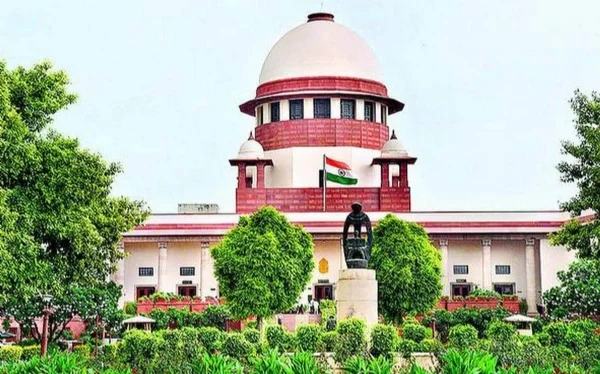
Many larger benches and Nine-judge Constitution Bench ruling in K.S. Puttaswamy v. Union of India (2017), has affirmed the law that the judgments of the Supreme Court can violate the fundamental rights of the Citizen and statutory bodies like national human Rights commission can investigate the violation and the aggrieved party can take steps by filing appropriate petition for correcting errors.
A Constitution Bench of the Supreme Court in Distributors (Baroda) (P) Ltd. v. Union of India, (1986) 1 SCC 43, in exercise of its writ jurisdiction, declared an earlier judgment of a smaller Bench of three Judges to be per incuriam, erroneous, and liable to be overruled. The Court emphasised that it is the duty of judges to correct the mistakes, observing that to perpetuate an error is no heroism, but to rectify it is the compulsion of judicial conscience.
- A recent order of a two-judge bench of the Supreme Court, perceived by many legal observers as being inconsistent with the nine-judge Constitution Bench ruling in S. Puttaswamy v. Union of India (2017), has ignited a nationwide debate on a profound constitutional question: Can judgments of the Supreme Court itself violate the fundamental rights of citizens, and if so, what remedies are available? The debate has also started whether despite knowing the gross illegality in any judgment can the court is powerless to correct it .
- The debate has crystallised around a fundamental proposition: Is the title of a petition more important than the illegality it alleges? If Article 142 exists precisely to remedy extraordinary injustice, the Court cannot be said to be powerless once the matter is before it. In Tamilnad Mercantile Bank Share Holders Welfare Association v. S.C. Sekar, (2009) 2 SCC 784, the Supreme Court held that even in the absence of a specific statutory remedy, once a matter is for hearing before the Court, it may exercise its powers under Article 142 to do complete justice and undo injustice. The Court emphasised that an aggrieved person cannot be left remediless, as access to justice constitutes a fundamental human right.
- This raises a deeper institutional question: Should the Supreme Court prioritise procedural closure or substantive justice when the two conflict? Indian courts have long held that pleadings must be read as a whole and that substance prevails over form; even mislabelled petitions have been treated according to their true nature where justice so requires. Courts exist to adjudicate grievances, not merely to police nomenclature.
- Ultimately, the controversy underscores a timeless constitutional principle: the legitimacy of the highest court rests not only on the finality of its decisions, but on public confidence that justice—not technicality—remains its guiding star.
- In its order dated February 13, 2026, in Maryamma Josh v. Union of India (Writ Petition (Civil) No. 113 of 2026), a two-judge bench headed by Justice Dipankar Datta dismissed the petition while observing that judicial orders passed by courts do not violate fundamental rights and therefore cannot be directly challenged through a writ petition, but only through remedies prescribed by law such as appeal or review.
- The two Judge bench relied on the landmark decision in Naresh Shridhar Mirajkar v. State of Maharashtra (1967), treating it as authority for the proposition that judicial orders of courts or tribunals cannot be regarded as violations of fundamental rights.
- However, the reliance has drawn sharp criticism from sections of the legal community, who contend that the observation overlooks binding later precedents of larger benches and developments in constitutional jurisprudence.
- The reliance on Naresh Shridhar Mirajkar is misplaced for two principal reasons.
- Firstly, in Mirajkar’s case the Nine-Judge Bench itself expressly clarified that it was not adjudicating the question whether judicial orders could violate fundamental rights under Articles 20, 21, or 22. The case was confined to the maintainability of a writ petition challenging an injunction order restricting publication, i.e., a matter relating to freedom of speech under Article 19 — a right that is expressly subject to reasonable restrictions imposed by law. The judgment therefore cannot be read as laying down a blanket proposition that judicial orders are incapable of infringing fundamental rights.
- Secondly, subsequent judgments of larger and Constitution Benches have clarified and developed the law, and this evolved position stands most authoritatively affirmed by the Nine-Judge Constitution Bench in S. Puttaswamy v. Union of India (2017) 10 SCC 1.
- Particular reliance has been placed on the later decision in Ram Deo Chauhan v. Bani Kanta Das (2010) 14 SCC 209, wherein the Supreme Court observed that the assumption that a judgment of the Supreme Court can never violate human rights is not correct. The Court referred, inter alia, to ADM Jabalpur v. Shivakant Shukla (1976), acknowledging that the majority view in that case had resulted in grave violation of fundamental rights. It further recognised that judicial orders of the Supreme Court may, in rare circumstances, lead to violations of human rights, and that statutory bodies such as the National Human Rights Commission may examine the consequences of such violations.
- This evolved constitutional position stands reinforced by the Nine-Judge Bench in Puttaswamy, which expanded the scope of Article 21 and affirmed that all exercises of State power must conform to constitutional guarantees.
- Accordingly, the view expressed by the Two-Judge Bench in its order dated 13.02.2026, insofar as it suggests an absolute immunity of judicial orders from fundamental-rights scrutiny, appears inconsistent with the binding principles laid down by the Nine-Judge Constitution Bench.
- The law is well settled that judicial orders of the Supreme Court may, in certain circumstances, result in violations of human rights, and that statutory bodies such as the National Human Rights Commission may examine the consequences of such violations and take appropriate remedial steps. However, for the purpose of correcting or setting aside a judicial order within the judicial framework, an aggrieved party is required to invoke the well-established corrective mechanisms available in law, including appeal, revision, review, curative petition, and other appropriate proceedings.
- This position was subsequently reinforced by the nine-judge Constitution Bench in S. Puttaswamy v. Union of India (2017).
- Irritation, Institutional Concerns, and Judicial Temperament :- Another dimension of the controversy relates to reports that courts sometimes display impatience when petitions seek to reopen settled matters. While the judiciary must undoubtedly guard against frivolous, repetitive, or vexatious litigation, Constitution Benches have emphasised that judicial temperament requires a careful balance — filtering abuse of process while remaining open to bona fide claims of injustice. In a constitutional system committed to the rule of law, the duty to prevent misuse of judicial process must coexist with the equally vital obligation to ensure that genuine grievances are not shut out on technical or procedural grounds.
- Duty of the courts to correct the mistakes and not to perpetuate it :-
- A Constitution Bench of the Supreme Court in Distributors (Baroda) (P) Ltd. v. Union of India, (1986) 1 SCC 43, in exercise of its writ jurisdiction, declared an earlier judgment of a smaller Bench of three Judges to be per incuriam , erroneous and overruled them where it was manifestly wrong, contrary to statutory provisions, or inconsistent with binding precedent. The Court emphasised that while judicial consistency and certainty are important, they cannot override the paramount requirement that the law be correct, nor can they be invoked to perpetuate legal error.
- The Constitution Bench firmly settled that courts are not to perpetuate illegality; rather, it is their solemn duty to rectify mistakes once they are brought to their notice. The Court observed that “to perpetuate an error is no heroism; to rectify it is the compulsion of judicial conscience.” It further underscored that a Judge must recognise human fallibility and remain ever ready to learn, be great and honest enough to discard mere pride of opinion and follow the truth wherever it may lead, and be courageous enough to acknowledge and correct errors when they occur.
It is ruled as under;
“2. … But having regard to various considerations to which we shall advert in detail when we examine the arguments advanced on behalf of the parties, we are compelled to reach the conclusion that Cloth Traders case must be regarded as wrongly decided. The view taken in that case in regard to the construction of Section 80M must be held to be erroneous and it must be corrected. *To perpetuate an error is no heroism. To rectify it is the compulsion of judicial conscience. In this we derive comfort and strength from the wise and inspiring words of Justice Bronson in Pierce v. Delameter A.M.Y. at page 18: “a Judge ought to be wise enough to know that he is fallible therefore everyday to learn: great and honest enough to discard all mere pride of opinion and follow truth wherever it may lead: and courageous enough to acknowledge his errors”.*
…the correctness of the view taken in that case has been challenged in the present writ petition. Since the decision in Cloth Traders Case (supra) was given by a Bench of three Judges, it is obvious that its validity can be canvassed before this Bench which consists of five Judges.
Ordinarily this Court would be reluctant to overturn a decision given by a Bench of this Court, because it is essential that there should be continuity and consistency in judicial decisions, and law should be certain and definite. It is almost as important that the law should be settled correctly. But there may be circumstances where public interest demands that the previous decision be reviewed and reconsidered. The doctrine of stare decisis should not deter the Court from overruling an earlier decision, if it is satisfied that such decision is manifestly wrong or proceeds upon a mistaken assumption in regard to the existence or continuance of a statutory provision or is contrary to another decision of the Court. (para 19)
…Both cannot stand together. If one is correct, the other must logically be wrong and vice versa. It is therefore necessary to resolve the conflict between these two decisions and harmonise the law and that necessitates an inquiry into the correctness of the decision in Cloth Traders case. . (para 19)
- … If, however, the decision of the smaller Bench is erroneous, the larger Bench has necessarily to interfere with the decision, as this Court will not permit a wrong decision to operate as good law of the land.
- But, even if in our view the decision in Cloth Traders case is erroneous, the question still remains whether we should over-turn it. Ordinarily we would be reluctant to over-turn a decision given by a Bench of this Court, because it is essential that There should be continuity and consistency in judicial decisions and law should be certain and definite. It is almost as important that the law should be settled permanently as that it should be settled correctly. But there may be circumstances where public interest demands that the previous decision be reviewed and reconsidered. *The doctrine of stare decisis should not deter the Court from over-ruling an earlier decision, if it is satisfied that such decision is manifestly wrong or proceeds upon a mistaken assumption in regard to the existence or continuance of a statutory provision or is contrary to another decision of the Court*. It was Jackson, J. Who said in his dissenting opinion in Massachusetts v. United States: *”I see no reason why I should be consciously wrong today because I was unconsciously wrong yesterday”.* Lord Denning also said to the same effect when he observed in Ostime v. Australian Mutual Provident Society: *”The doctrine of precedent does not compel Your Lordships to follow the wrong path until you fall over the edge of the cliff”.* Here we find that there are over-riding considerations which compel us to reconsider and review the decision in Cloth Traders case. In the first place, the decision in Cloth Traders case was rendered by this Court on 4thMay 1979 and immediately thereafter, within a few months, Parliament introduced Section 80AA with retrospective effect from 1stApril 1968 with a view to over-riding the interpretation placed on Section 80M in Cloth Traders case. The decision in Cloth Traders case did not therefore hold the field for a period of more than a few months and it could not be said that any assessee was misled into acting to its detriment on the basis of that decision.
There is also another circumstance which makes it necessary for us to reconsider and review the decision in Cloth Traders case and that is the decision in Cambay Electric SUPPLY Company’s case. The decision in Cloth Traders case is inconsistent with that in Cambay Electric Supply Company’s case. Both cannot stand together. If one is correct, the other must logically be wrong and vice versa. It is therefore necessary to resolve the conflict between these two decisions and harmonise the law and that necessitates an inquiry into the correctness of the decision in Cloth Traders case. It is for this reason that we have reconsidered and reviewed the decision in Cloth Traders case and on such reconsideration and review, we have come to the reconsideration that the decision in Cloth Traders case in erroneous and must be over-turned.”
11. Instances Where Supreme Court Set Aside Its Own Orders :-
11.1. Several landmark decisions demonstrate that the Supreme Court has, on multiple occasions, revisited and nullified its own earlier orders upon finding jurisdictional error or violation of constitutional rights.
11.2. One of the most significant precedents remains A.R. Antulay v. R.S. Nayak (1988) 2 SCC 602, where a seven-judge bench set aside an earlier order of a five-judge bench under Article 136, holding that the previous directions of the Supreme Court had deprived the petitioner of his statutory right of appeal and violated his rights under Articles 14 and 21 by subjecting him to unequal treatment.
11.3. In M.S. Ahlawat v. State of Haryana M.S. Ahlawat v. State of Haryana, (2000) 1 SCC 278, a three-judge bench set aside a contempt conviction imposed earlier by a two-judge bench, holding that the order had been passed without jurisdiction and in violation of statutory provisions and thereby violating fundamental rights of the Petitioner who was a Police Commissioner.
11.4. Similarly, in Supreme Court Bar Association v. Union of India (1998)4 SCC 409, a five-judge Constitution Bench invalidated directions issued by a three-judge bench after concluding that the earlier bench had acted beyond the limits of contempt jurisdiction.
11.5. More recently, in Confederation of Real Estate Developers of India (CREDAI) v. Vanashakti 2025 INSC 1326 , a three-judge bench set aside an earlier two-judge bench order after finding it per incuriam.
12. Supreme Court’s Inherent Power to Correct Errors
12.1. Legal commentators emphasise that the Supreme Court has repeatedly affirmed its inherent jurisdiction to correct its own mistakes to prevent injustice.
12.2. In paragraph 48 of A.R. Antulay, the Court declared that it is not powerless to rectify errors that deprive a citizen of fundamental rights, and may do so in any proceeding pending before it without insisting on procedural formalities.
12.3. The Court held that powers of review could be exercised under Articles 32 or 136, or under inherent jurisdiction, where earlier directions had resulted in deprivation of life, liberty, or legal rights.
12.4. The Seven-Judge Bench in A.R. Antuley’s case (1988) 2 SCC 602, observed as under;
“48. According to Shri Jethmalani, the doctrine of per incuriam has no application in the same proceedings. We are unable to accept this contention. We are of the opinion that this Court is not powerless to correct its error which has the effect of depriving a citizen of his fundamental rights and more so, the right to life and liberty.
It can do so in exercise of its inherent jurisdiction in any proceeding pending before it without insisting on the formalities of a review application. Powers of review can be exercised in a petition filed under Article 136 or Article 32 or under any other provision of the Constitution if the court is satisfied that its directions have resulted in the deprivation of the fundamental rights of a citizen or any legal right of the petitioner. See the observations in Prem Chand Garg v. Excise Commissioner [AIR 1963 SC 996 : 1963 Supp (1) SCR 885] .”
It was specifically ruled by the bench that
” But the superior court can always correct its own error brought to its notice either by way of petition or ex debito justitiae. See Rubinstein’s Jurisdiction and Illegality).”
- This principle aligns with the Court’s broader constitutional duty not to perpetuate illegality.
- Recently, a Three-Judge Bench of the Supreme Court in Vishnu Vardhan v. State, 2025 SCC OnLine SC 1501, authoritatively reaffirmed the jurisdiction of the Supreme Court to reconsider and revisit its own earlier orders. The Court held that under Order LV, Rule 6 of the Supreme Court Rules, 2013, the Supreme Court possesses inherent powers to secure complete justice. It was emphasized that procedural laws cannot be permitted to tie the hands of the Court in a manner that defeats the rights and interests of affected parties. The Bench categorically observed that the ends of justice demand that grossly unlawful or fraudulent orders must not be allowed to remain on the record of a Court of Record.
- Order LV, Rule 6 of the Supreme Court Rules, 2013, expressly provides:
“Nothing in these rules shall be deemed to limit or otherwise affect the inherent powers of the Court to make such orders as may be necessary for the ends of justice or to prevent abuse of the process of the Court.”
- Universal Right to Effective Remedy :- The Universal Declaration of Human Rights, 1948, which forms the foundation of modern international human rights jurisprudence, expressly recognises the right of every individual to access effective judicial remedies for acts violating the fundamental rights granted him by the Constitution or by law and in the determination of his rights and obligations, and of any criminal charge against him.
- These provisions embody the principle that no legal system can claim to be just unless it provides a meaningful mechanism to correct violations of fundamental rights.
- The constitutional status of international human rights instruments was emphatically affirmed by the Nine-Judge Constitution Bench in S. Puttaswamy v. Union of India, (2017) 10 SCC 1, wherein it was held that rights recognised under the ICCPR and other international conventions are to be teated as a part of the Art 21 of the Constitution and its violation is enforceable like the violation of Art 21.